Toy Story 5, 2026.
Directed by Andrew Stanton.
Featuring the voice talents of Tom Hanks, Tim Allen, Joan Cusack, Greta Lee, Conan O’Brien, Craig Robinson, Shelby Rabara, Tony Hale, Scarlett Spears, Jay Hernandez, Lori Alan, Bonnie Hunt, Kristen Schaal, Wallace Shawn, John Ratzenberger, Blake Clark, Jeff Bergman, Anna Vocino, Annie Potts, Mykal-Michelle Harris, Keanu Reeves, Ernie Hudson, Jeff Garlin, Melissa Villaseñor, Matty Matheson, John Hopkins, and Jeff Pidgeon.
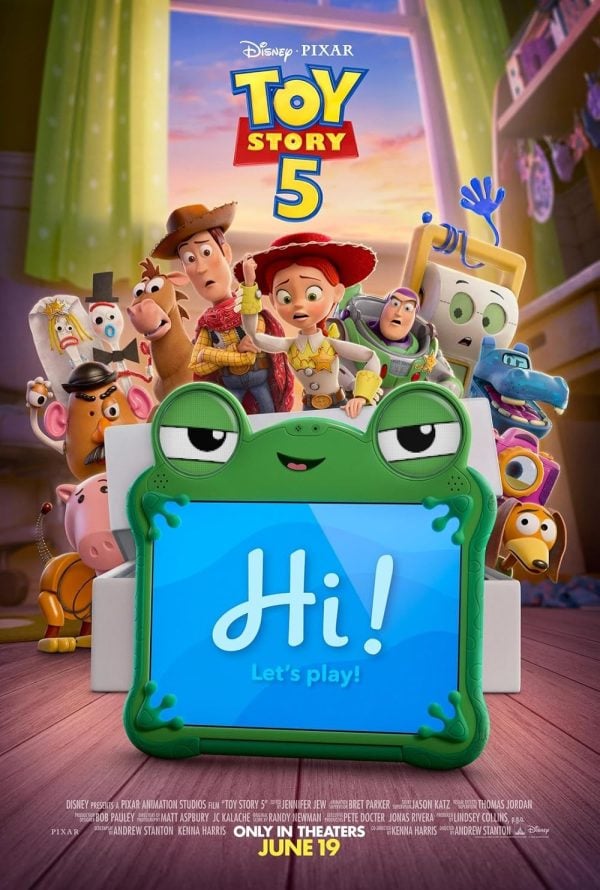
SYNOPSIS:
Woody, Buzz, Jessie and the rest of the gang’s jobs are challenged when they’re introduced to electronics, a new threat to playtime.

Although it may seem 10 or 15 years too late for old-fashioned toys vs technology (shouldn’t this already have been more prominent since there is an entire video game centering Buzz Lightyear against nemesis Zurg?), not to mention a film or two past a definitive, perfect conclusion, Toy Story 5 exists and, for the most part, continues to prove true that Disney and Pixar pride the series too much to put out a clunker. Thankfully so, as this is one of our most beloved franchises, and nothing any critic says will prevent it from making another billion dollars (a good portion of that might come from Swifties alone, who will no doubt be happy with the end-credits song).
Once again, there is a thoughtful approach to placing the toys’ roles front and center in an ever-evolving technological and societal culture, while also reaching for and earning heavy emotional payoffs for toys and children alike. Directed by Andrew Stanton and co-directed by Kenna Harris, this time the story is, perhaps more than ever, concerned with how those children are growing up in a tech-obsessed world, what digital friendship sometimes unfortunately looks like, what a real friend is, and how to even make friends when one’s interests haven’t quite caught up with the times, which here results in a disinterest in letting someone into a friend circle. In other words, this installment draws much inspiration from the Inside Out series, with emphasis on a child’s feelings.
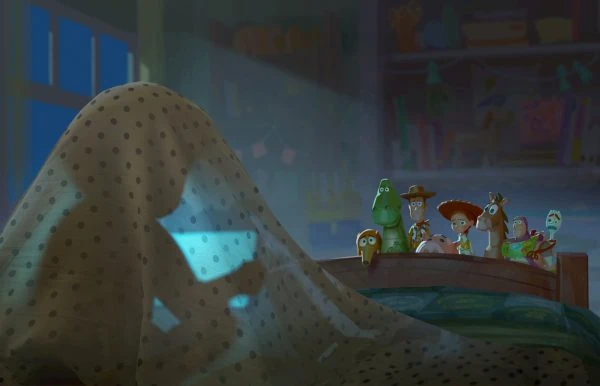
Making matters more stressful is that these are mostly still young children, typically eight years old, tossed such devices that are meant to entertain and lecture, and sometimes relieve parents by doing some of the raising. That also means that if a child doesn’t fit in, bullying unfortunately occurs at an earlier age. It’s already hard growing up, and technology, for all the positives it can provide, has only complicated matters, sometimes functioning as an inhibitor.
The referred device and primary new non-human character is Lilypad (voiced by Greta Lee), a riff on iPads intended for early childhood development, with the idea being that it’s not exactly social media but rather a closed circuit for nearby children to text or play games cooperatively. Theoretically, it is a system designed to encourage children to connect in real life through parents arranging playdates, sleepovers, and whatnot, except the kids no longer have an imagination for playing with standard toys, preferring to rot their eyes staring at Lilypads.
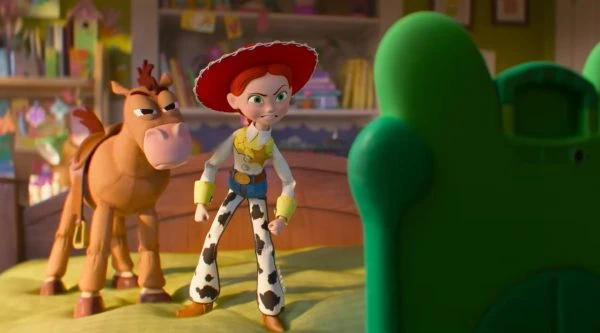
Still the new owner of the fan-favorite toys, Bonnie (now voiced by Scarlett Spears), clings to that imagination, although her joy of playing with Jessie (voiced by Joan Cusack), Buzz Lightyear (voiced by Tim Allen), and the rest of the gang makes her the target of awkward stares and difficulty making friends. Torn between a feeling that it’s time to move on and put the effort into making, friends, her parents (voiced by Jay Hernandez and Lori Alan) purchase a Lilypad, which quickly grabs a hold of her attention and not only takes her time away from the toys, but also proves to be addictive as the device, while well-meaning with its own conscience, as do the other toys (one could argue that there are some AI parallels here, although it’s more logical to treat her as another toy character similar to the rest), granting her the illusion of friendship; talking and texting and playing with nothing meaningful happening under the surface.
That’s also not to say the film is anti-technology, as the Internet has proven to be a double-edged sword, also incredibly useful for making like-minded weird friends, which is something the story does eventually get around to as the classic and new toys must find a way to co-exist and accomplish their goal of servicing Bonnie with whatever is best for her. This time around, that takes the form in what is mostly a story centered on (in terms of toys) cowgirl Jessie and her expressively loyal horse companion Bullseye, undergoing an existential crisis as a now-balding but still outdoors Woody (voiced by Tom Hanks) and Buzz Lightyear have done before her, going on an adventure that brings her back to her original farm home, with a new family and young girl, Blaze (Mykal-Michelle Harris) residing in it, all on a journey of self discovery seeking purpose and what, if anything, she has meant to her owners.

While exploring the surrounding area, Jessie meets some outdated electronic toys thrown away in storage and forgotten about, including talking digital camera Snappy (Shelby Rabara), slowpoke GPS Atlas (voiced by Craig Robinson), and who will go down as unquestionably the most memorable and funny of the new batch, a potty-trainer voiced by Conan O’Brien, armed with, well, literal toilet humor puns.
Unsurprisingly, Jessie initially resents these toys and has no interest in working together, perceiving them as having no use beyond distraction and killing imagination (the filmmaker smartly go out of their way to make the point that playing with electronic devices or games is not the same thing as using the mind to invent fantastical stories and characters dolls and action figures), although it soon becomes clear that these are earlier models and offshoots of the Lilypad (they all even sync up to the same cloud-based network), who have meant well regarding early education and development, or making memories together with their owner (in the case of Snappy, she can store pictures of them for added special value). They, too, have seen the end of their time, which Jessie can relate to.
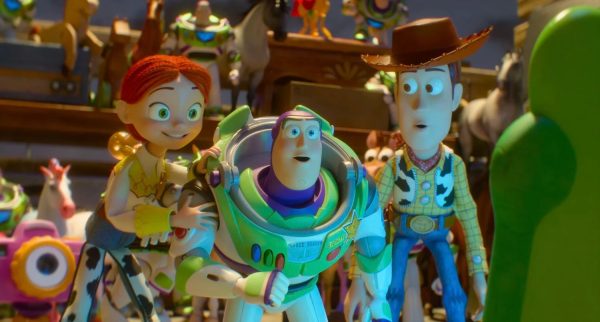
Elsewhere, a group of high-tech Buzz Lightyears have escaped from crashed transportation and taken it upon themselves to go on their own mission, searching for Star Command. Naturally, these are the variety who have no connection to Woody or the other toys (many of whom return, ranging from Rex, Mr. Potato Head, Slinky Dog, Forky, and others, all given solid jokes here for the perfect small dose of nostalgia). These brief scenes make for amusing diversions while awaiting discovering how they inevitably come into the bigger picture.
At times, one wishes Toy Story 5 took the gloves off and leaned harder into how dangerous to the mind technology could be, especially at an early age (the film even acknowledges with a throwaway self-aware joke that it is questionable buying a device like the Lilypad for a child in the first place, and that they even exist, but never really follows through on it). However, there are a couple of background visual gags demonstrating this and how addictive technology can be for adults as well. Instead, it comfortably retreads familiar territory about whether these toys (including the earlier, outdated electronic ones) have outlived their usefulness, but this time through the lens of a different toy anchoring the story.

Fortunately, that emotional payoff for Jessie hits hard, as does Bonnie’s shy, misfit arc, longing to be accepted by a friend. These newer entries were never going to match the sheer, devastating emotional force, catharsis, and finality of the third entry’s climax, or even reach the series’ comedic highs, but at the very least, they live up to the franchise’s expected quality. They have friends in us for life. For Toy Story 5, better late than never to explore toys and tech.
Flickering Myth Rating – Film: ★ ★ ★ / Movie: ★ ★ ★ ★
Robert Kojder