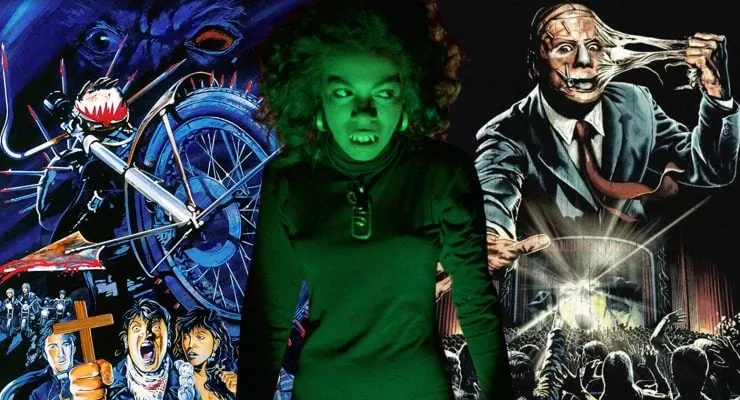
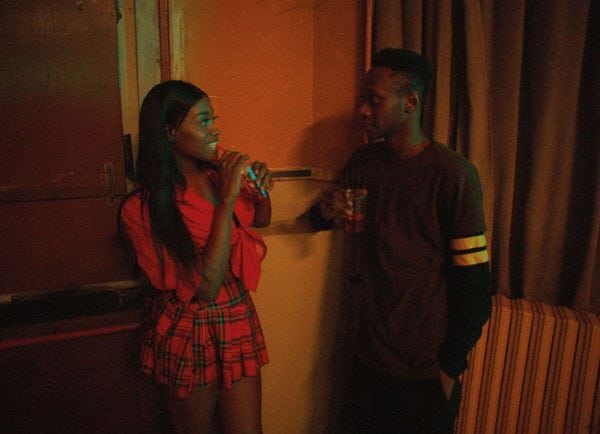
Climax is an aesthetically unique film. Though it very clearly the work or Gaspar Noé, there is also a strong focus on dance. I’m no dance expert, so I can’t comment on the dancer’s performances in and of themselves, but it is clear that Gaspar wishes to capture the raw energy and chaos of what appears to be various different styles of contemporary dance. In this respect, he does a good job. When we first see the dancers, the camera has little input into their movements, letting the dance speak for itself, near enough. However, after the dancers have their drinks spiked, the camera becomes more involved, weaving between them, blacking in and out as the lights flash, making the scenes gradually more and more nightmarish. The content of each scene also gets darker. Beginning with conversations about relationships, which turn into conversations about violence and sex, and eventually ending up with actual violence and sex.
The combination of dynamic camera movements, realistic violence, increasingly unusual and disturbing dance, and a growing sense of paranoia as the drug takes a stronger hold of the characters, really forces the audience into feeling what the characters feel. For that reason, Climax becomes unbelievably uncomfortable as time rolls on, and by the end it feels like you’ve been plunged into hell. However, all these features are surface level. Clever in a way that a craftsman is clever when they make something functional, but not clever in a way that an artists is when they make you feel something by teaching you something else.
What an earth does that mean? Let’s go back to Ant Man and the Wasp and First Reformed for a second.
When you watch a good blockbuster, you’re not just entertained by the flashing lights and the loud noises; you’re entertained by the story itself. Why? Because you learn something. Whether you learn the secret of what’s inside the mystery box, how to defeat the villain, or the origin of some mysterious force (or whatever else you can think of) it doesn’t matter. What matters is that you learn something. Sometimes you won’t learn anything new per se, but you will add little bits to your knowledge about a subject.
To be clear, I’m not saying that you learn facts about the world such as how far away the moon is or how many atoms make up your body. What you learn are facts about the human condition. In blockbusters, you most commonly learn about what it is to be a hero. You witness a character shed their insecurities, go out into the world and confront their demons, and come back a better person for it. Through watching this, you learn how to be a hero and how to live your life in a more heroic way. Sure, you’ll never have to fish your wife out of the quantum realm or fight an actual demon, but you better understand how to deal with the real-life problems you face, whether you realise it or not.
Character driven fiction is a little more complex, but works in much the same way. Rather than using an unrealistic scenario as an understandable and archetype-extracting metaphor for a real human struggle, it simply shows a realistic scenario and gives us a complex guide (the lead character) to show us the way. Unlike genre films, they don’t always show us the way by making the world better. Sometimes they make it worse, but by the fact that we are shown the consequences of their actions, we can extrapolate what the correct course of action should have been.
Taking this back to First Reformed, we see The Priest go from an understanding man to one who is prepared to kill many for the apparent betterment of the planet. His actions are not shown as excusable, but they are presented as understandable. Ergo, we extract some of the complexity involved in the psychology of, in this film’s case, suicide bombers. We don’t learn everything (because we don’t know everything) but we learn far more than we do by simply watching the news and hearing brief titbits of information about real life bombers. The film dives us into subjectivity, and more importantly a subjectivity that only really film or literature can communicate. The director still carefully chooses what he wants to show, allowing for certain features to rise to the surface, as the film has a point it is trying to make, but it doesn’t shy away from presenting this point in the context of different perspectives.
I’d argue that for a film to be considered a true piece of art, it must educate in a way that a film like First Reformed does and employ aesthetic qualities that help drive this learning, or at least effectively evoke additional emotional responses. This, ladies and gentlemen, brings me back to Climax one last time, as I believe it fails utterly to do this.