The Two Popes, 2019
Directed by Fernando Meirelles.
Starring Jonathan Pryce, Anthony Hopkins, Sidney Cole, Juan Minujín, and Federico Torre.
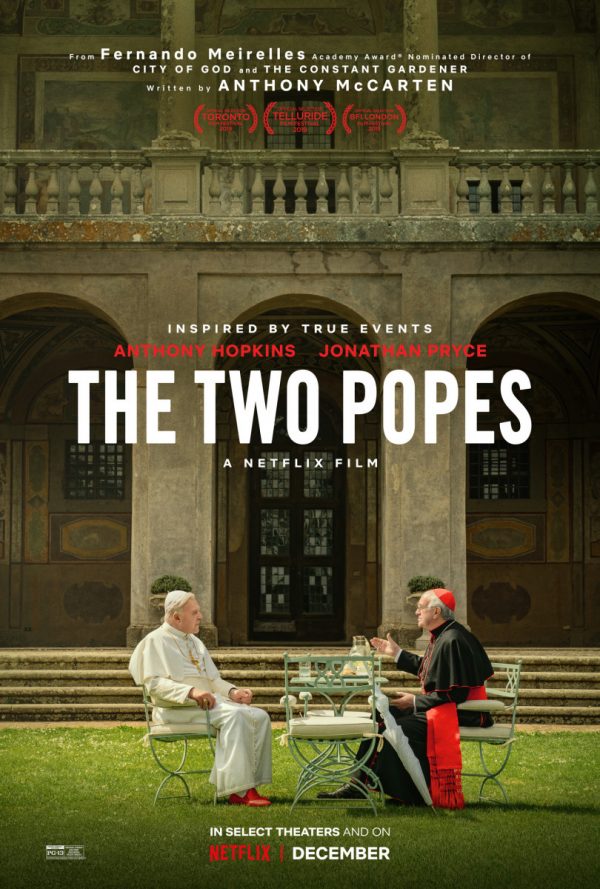
SYNOPSIS:
The Two Popes explores the relationship and opposing visions between two of the most powerful leaders in the Catholic Church, both of whom must address their own pasts and the demands of the modern world in order to move the church forward.

At first glance, it’d be easy to expect The Two Popes to be overly didactic.
Certainly, insofar as the film is a character study of two men, it is far more deeply concerned with Pope Francis than his predecessor Benedict XVI (the title of the play that inspired The Two Popes, of course, was simply The Pope: indicative, perhaps, that the piece once had an even more singular focus). Indeed, Anthony McCarten’s script is fascinated by Francis – a fascination keenly felt as the film considers the days leading up to the resignation of Pope Benedict, imagining the conversations he may have had with his eventual successor. The pair are defined in opposition to one another, establishing a dichotomy that forms the spine of the film. Conservative and reforming; reserved and open; the past and the future. Two different interpretations of faith, two different visions for a Church in crisis.
The Two Popes begins and ends with Francis, not just fascinated by him but enamoured with him. McCarten and director Fernando Meirelles build the film around Francis and his perspective, offering an extended account of Francis’ history within the Church, emphasising his critiques of Benedict’s Papacy. It’s anchored by an understated, yet evocative performance from Jonathan Pryce. Often, with biopics, there’s an inclination to measure an actor by how closely they resemble their subject. In that regard, Pryce is an unqualified success – when The Two Popes intercuts real footage of Francis with recreations featuring Pryce, it can be genuinely difficult to tell which is which. More crucially, though, Pryce excels at recalling the public face of a private man, creating a coherent character in the space between the Pope and The Two Popes.
In contrast, viewed primarily through Francis’ eyes, Benedict at times seems inscrutable. The former Cardinal Ratzinger is placed at a distant, deliberate remove – not just from Francis or the Church, but the viewer as well. In part, that’s the point; despite their differences, they’re the only two men who could ever truly understand one another – but that understanding can only come as the film ends. It leaves Hopkins with the more difficult task, as an actor. Unsurprisingly, he rises to it; Hopkins’ portrayal of a Pope adrift is the perfect counterweight to Pryce. Even so, it’s hard not to wish that Meirelles and McCarten had extended the same interiority to Benedict as they did Francis.

In its weakest moments, The Two Popes treats Benedict as an aberration, an interruption that needed to be corrected by Francis – at times, the affection felt towards the current Bishop of Rome risks tending towards the hagiographic.
And yet The Two Popes clearly aspires to a more complicated narrative. Central to this story are the sexual abuse cases that came to light towards the end of Benedict’s papacy. It’s a fraught subject, and The Two Popes is necessarily precise in approach – the careful levity of McCarten’s script is easy to appreciate, conscious in how it threads the needle between this and its otherwise gentle humour, never quite polemic or farce.
What is interesting, though, is how The Two Popes positions Francis in relation to Benedict here. The aforementioned flashbacks, detailing Francis’ life within the church, is in fact an interrogation of his tacit collaboration with Argentina’s fascist dictatorship of the 1970s. (Juan Minujín, under-discussed in comparison to Jonathan Pryce, is particularly compelling as the young Pope Francis – it’s difficult to imagine the film working as well as it does without him.) Parallels – sketched lightly, left implicit, but parallels all the same – are drawn between Francis’ years as a Bishop and Benedict’s tenure as Pope, questioning what each man knew, how much they were truly responsible for. In these moments, the fluency and tact of Meirelles direction is more closely felt; intimate close-ups stripping away the grandeur of the Vatican, brushing away the weight of history and of authority to instead dwell on the personal. Hopkins and Pryce fill the screen – the camera lingering on every epiphany, every revelation, every long-repressed emotion finally felt. Much of Catholic theology revolves around ideas of sin, ideas of guilt; The Two Popes, in keeping with this, casts the two most influential figures of the Church as penitent men. For one, penance comes in renouncing the papacy – the other, in assuming it.
In the end, the two men absolve one another. Whether the absolution is deserved is, perhaps, another question. Certainly, for all that Francis is a more progressive pontiff than his predecessor, he isn’t perfect either; indeed, his own handling of continuing clerical abuse has been criticised as well, promises of decisive action at times giving way to support for the accused over the victims. A closing montage of papal visits around the world feels a touch too earnest – The Two Popes is best where it resists a simple interpretation of Francis’ succession as Pope. That final, almost egregiously teleological note (drawn out as it is – The Two Popes is blunted by an inability to choose one ending, even to the point of having a post-credit scene) is the greatest strike against the film’s claim to complexity.
Perhaps, though, that’s unsurprising for a film so concerned with forward motion – a running theme across the film, from Meirelles’ surprisingly kinetic direction to the recurring wind motif (the winds of change) in the sound design. Even as it avoids the worst didactic excesses, The Two Popes never loses sight of its destination – and fails to ask if enough really changed along the way.
Flickering Myth Rating – Film: ★ ★ ★ ★ / Movie: ★ ★ ★ ★
The Two Popes is in cinemas from 29th November 2019, and on Netflix from 20th December 2019.
Alex Moreland is a freelance writer and television critic; you can follow him on Twitter here, or check out his website here.