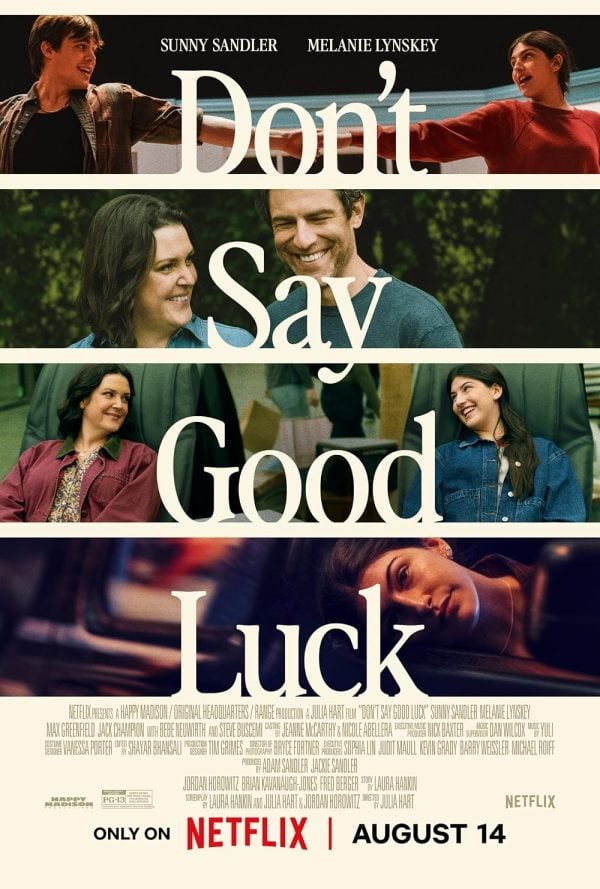
Don’t Say Good Luck, 2026.
Directed by Julia Hart.
Starring Sunny Sandler, Melanie Lynskey, Max Greenfield, Stephanie Beatriz, Bebe Neuwirth, Steve Buscemi, Jack Champion, Jon Lovitz, Scarlett Estevez.
SYNOPSIS:
Sophie Birenbaum is ready for the spotlight as the lead in her high school musical — until suddenly she’s living with even more drama at home than on the stage.
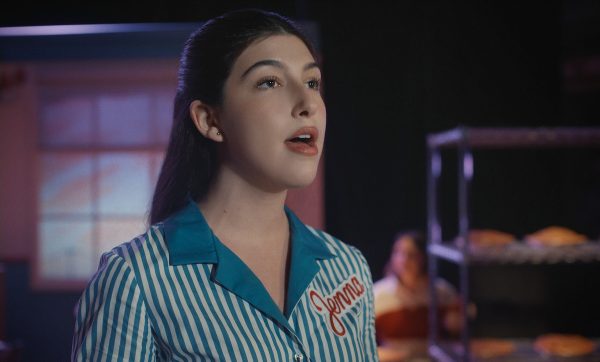
As Sophie Biranbaum (Sunny Sandler) nervously auditions for a major role in her high school’s theatrical production of Waitress, her mom Elizabeth’s (Melanie Lynskey) cancer has returned with a vengeance. It’s a dynamic that could understandably cause one to presume that Don’t Say Good Luck will be a generic, sappy disease flick, but this is a film with a skilled director at the helm in Julia Hart (collaborating with screenwriter/husband Jordan Horwitz and Laura Hankin) at bringing out emotional honesty from the story and characters, continuing a new age of Happy Madison productions with less interest in parading Adam Sandler and friends through the laziest of lowbrow scenarios, but rather something different and typically led by one of his daughters (you can shout nepo baby, sure, although they are progressively becoming as legitimate as anyone else who could be seen in these roles).
Shying away from such juvenile antics (although, to be fair, there is a Grown-Ups 3 around the corner so perhaps I’m giving the company too much credit) is already a refreshing victory. However, the narrative here also eschews manipulating the heartstrings for something much more nuanced, grounded in teenagers, the theater scene, and familial loss, with an emphasis on tough choices, guarded emotions, and the resulting organic friction. Even the supporting cast of Happy Madison regulars (Jon Levitz and Steve Buscemi, with the latter of whom is practically capable of playing any type of role and excelling) are here to accentuate the natural drama, rarely playing to their comedic strengths (and on the off chance that they do, it fits without drawing attention to itself).
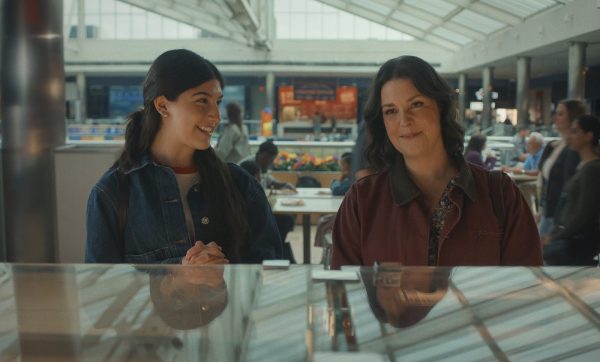
The other welcome, rewarding layer is perhaps obvious but nonetheless satisfying, as the role Sophie prepares for, under the tutelage of an invested, sweet instructor and director played by Stephanie Beatriz, gradually becomes a vessel for her real-life feelings, a search for acceptance of what’s happening to her mom, catharsis, and a coping mechanism. As such, the song lyrics begin to take on double meanings to successful emotional effect, especially during the third act. From tech night parties to questionable crushes (Jack Champion portraying a stage partner who could be as untrustworthy as his character offstage) to strained friendships (Scarlett Estevez as the BFF convinced that Sophie has too much on her plate with not enough time for her), and a family slowly coming apart, the filmmakers also convey conflict without blowing it up and sacrificing that naturalism. Rather movingly, it’s a film about life impacting art and vice versa.
That’s not to say everything the story does is subtle, but it has the restraint and dignity not to resort to desperate tears. By the end, one feels as if they have simply been by Sophie’s side through a complicated and challenging time in her life, amid her aspirations, burgeoning interest in romance, and the unfathomable, impending early loss of her mother. It also cannot be understated how remarkable Melanie Lynskey is in that performance, putting on a strong face and body language, saying one thing but wishing for another deep inside, all in the name of wanting what is best for her daughter while simultaneously wanting more time together.
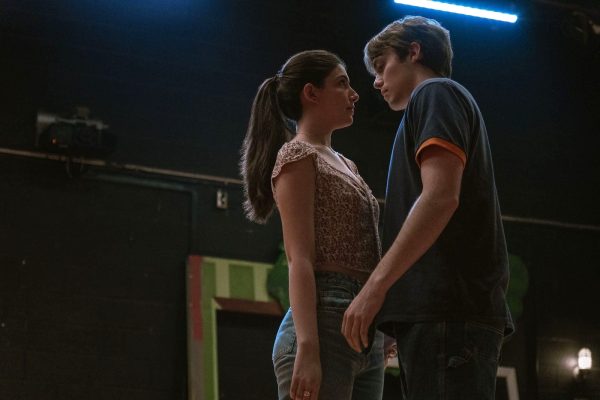
There is a questionable, contrived creative choice in that Sophie only learns of the cancer returning (and other family details) when her father, Ted (Max Greenfield), constantly butt-dialed whenever the story needed to hand that information to her. Initially, it is presented as a joke before the gag begins to relay important information in what can only be generously described as convenient and unconvincing. Nevertheless, it’s not enough to ruin the goodwill, since Don’t Say Good Luck knows how to wring authentic drama from the characters and the depressing situation. It’s another winner for this B-side of the Sander family and Happy Madison, although they might need to change the label to Sad Madison after this one.
Flickering Myth Rating – Film: ★ ★ ★ / Movie: ★ ★ ★
Robert Kojder