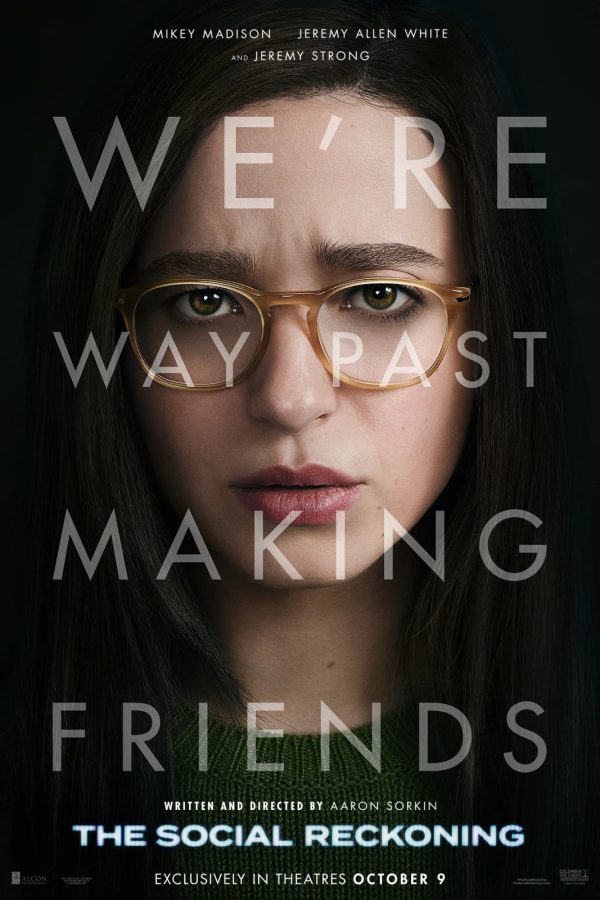
The Social Reckoning, 2026.
Written and Directed by Aaron Sorkin.
Starring Mikey Madison, Jeremy Allen White, Jeremy Strong, Wunmi Mosaku, Betty Gilpin, Billy Magnussen, Bill Burr, Gbenga Akinnagbe, Anna Lambe, Aidan Laprete, Kelley Pereira, Nelson Franklin, Portia Doubleday, Patrick Fischler, Joseph Brooks, Sierra Capri, Tehmina Sunny, and Matthew Nelson-Mahood.
SYNOPSIS:
Follows Frances Haugen, a young Facebook engineer, who enlisted the help of Jeff Horwitz, a Wall Street Journal reporter, to blow the whistle on the social network’s most guarded secrets.

“It’s true, I saw it on Facebook!” – an actual line from one character’s date that would instill further doom just from trying to pinpoint an accurate estimate of how many people ignorantly utter the same phrase daily (or even by the hour) outside of movies. It’s reasonable to suggest that everyone reading this review probably knows someone who has said it, and that the responsive notion that Facebook is not journalism is likely rejected or outright ignored. With that in mind, it’s also understandable why writer/director Aaron Sorkin likely feels that the story The Social Reckoning (doing it himself this time, as David Fincher was uninterested in directing this follow-up) tells is vital.
And while it’s never too late for those unaware of what’s happening to get a crash course in an important subject, there is also a sense that the details provided here are already missing much of what follows in the years that come. By the end, The Social Reckoning feels like an incomplete one, or one that either has no interest in, or was simply written too long ago to, for lack of a better term, reckoning with the current moment.
There is an awkward, misguided, triumphant ending that takes place long before Donald Trump was reelected, which is worth mentioning given that this is a movie about the social media company (which now also owns Instagram and who knows how much else, considering how rampant and unchecked these monopolistic acquisitions have become) encouraging extremist groups on all sides, which arguably hasn’t played a bigger role than in the most recent presidential election. More baffling is that at points I was more interested in whether or not two of the key characters ended up together romantically in real life (one would presume that Mikey Madison would get to set aside the dresses and whatnot for the Facebook movie where she plays a data scientist, but at times her wardrobe consists of outfits that could have been utilized in Anora, albeit without the undressing here).
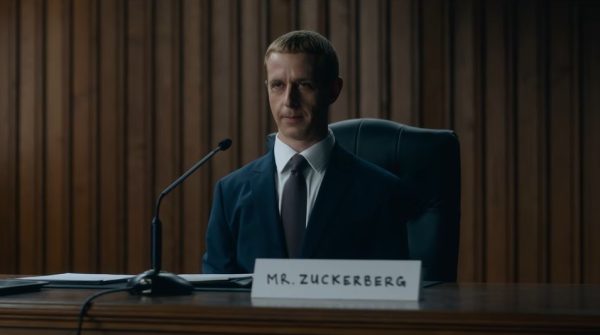
It’s as if The Social Reckoning was written at a time and by someone who thought it inconceivable that Donald Trump could get elected again, especially following the January 6th insurrection riots. Since the Facebook CEO is more of a supporting player this time around, with Jeremy Strong replacing Jesse Eisenberg as Mark Zuckerberg, the meat of the story is told elsewhere and through the lens of politics, which makes sense coming from Aaron Sorkin.
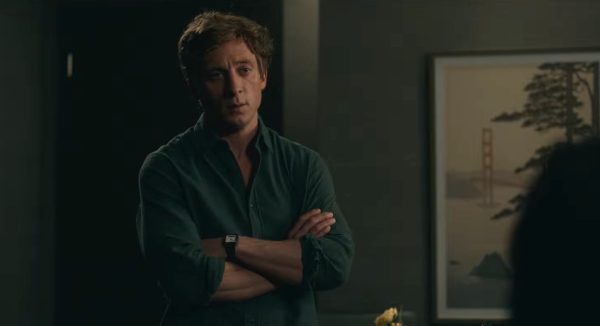
Broken into timelines that flash back and forth on a collision course, the story belongs to an investigative reporter collaborating with the Wall Street Journal, Jeremy Allen White’s Jeff Horwitz, looking into amplified positive live comments toward Mark Zuckerberg keynote feeds and whatnot, alongside the theoretical suppression of negative comments. Poking and prodding around, he is emailed by Mikey Madison’s data scientist, Frances Haugen, who believes in the Facebook mission of meaningful social engagement and connection and has no interest in whistleblowing (both because it’s against the law and she doesn’t want to betray a company and platform she finds value in), but can’t sit by and have her legitimate concerns hand-waved away by superiors and colleagues.
The gist is that the company is being deceitful regarding the coding behind a new algorithm dubbed MSI (Meaningful Social Interaction), in which it’s not just about prioritizing content such as wedding photos or other significant life milestones, but targeting and driving high-end users (in some cases up to nine hours a day) toward extremist political groups in the hope of radicalizing them and re-sharing posts from those pages, as that’s the hotbed for engagement. That whole system of likes, emojis, and re-shares? Yeah, viewers will come away here rethinking how they use it going forward.

Meanwhile, in early 2021, Mark Zuckerberg is preparing for a defense alongside crisis manager Raya (Wunmi Mosaku), fielding the hardest and heaviest questions from former friend turned adversary Charlie (Bill Burr, a match made in heaven for handling heated, rapid-fire Aaron Sorkin dialogue), as cold as ever, unwilling to see why Facebook should implement some sort of fact-checking for political ads. As for Jeremy Strong, he certainly has the appearance of Mark Zuckerberg, but the voice is so overdone in a stilted, robotic tone that it crosses into parody. That’s not to say Mark Zuckerberg isn’t cold and strange, but the performance doesn’t necessarily ring true.
Similarly awkward is the odd pairing of Frances and Jeff, with the former seemingly terminally online and the latter disdainful of social media. Both are socially maladjusted, but the film doesn’t pull on that thread or how they are alike despite being so different as much as it should, instead making sure there is time for quips and other bits of humor. Again, while watching this, you can’t help but feel that the saying “opposites attract” is at work, but the film is wishy-washy about that element as well. And if nothing ever happened between these two in real life, why the hell is the story giving the characters such tension?

There are also passing references to Instagram’s controversies with cyberbullying, and numbers referring to both platforms being harmful to the self-esteem and body image of teenagers using them. It’s an even smaller piece of a film that already feels like a small piece of what should be a much larger story. The Social Reckoning commendably highlights these issues for those not in the know and provides more context for those familiar with this expose, but it’s not dramatically compelling and is cinematically dull (as if it would have been right at home on TV), with the absence of director David Fincher and composers Trent Reznor and Atticus Ross felt. Before The Social Network was released, it garnered ridicule that a movie about Facebook, of all things, was even made. The film spoke for itself and is now considered a modern classic. In some ways, The Social Reckoning is the film we feared back then.
Flickering Myth Rating – Film: ★ ★ / Movie: ★ ★ ★
Robert Kojder