Deadline, 2025.
Directed by Kiwi Chow.
Starring Anthony Chau-Sang Wong, Allison Lin, Jimmy Liu, Yi-mei Shao, Run-yin Bai, Michael Chang, Di-yang Huang, Ya-zhi Tai.

SYNOPSIS:
An anonymous suicide notice at a prestigious private high school force staff and students to confront the pressures of academic achievement, family expectations, and the school system itself.
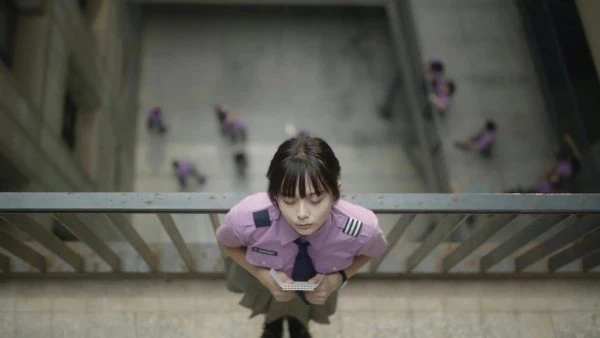
On 12 December 2025, Deadline, the latest film by Kiwi Chow, was refused approval by Hong Kong’s film censorship authority for screening in its home country. Following this announcement, anticipation for Deadline’s eventual release grew exponentially. What sort of film had Chow produced that could cause national security concerns? Filmed entirely in Taiwan with the backing of the Taiwanese government, Deadline proves to be a bold statement on a society so dedicated to success, particularly in education, and how this mindset reflects broader societal issues.
The film is dystopian in its presentation, primarily taking place at En-Shan High School, which utilises a system that scores not only every student but also every teacher. Cameras are present in every classroom and corridor, while banners displaying the top-ranked student in each year hang above the school courtyard. The higher your rating, the more privileges and luxuries you receive, while those lower down the rankings are subjected to punishment. This tiered approach to society breeds division, as once different classes of people are created, anyone can be relegated to the lowest rung. In such a system, true equality and freedom can never exist.

While the film takes place within a school, it is easy to see the real-world implications that Chow is drawing upon. Tackling themes of freedom and surveillance, it explores how, in a society where the only thing that matters is how a system judges us, individuals are forced to appease that system. We see the devastating impact this has on many of the students. Ruoyan (Yi-Mei Shao), burdened by the pressures of coming from a lower-class family, begins to suffer a mental breakdown. She cuts her legs with a craft knife and relies on smart drugs that enhance attention and learning, all in an effort to become the best in her year. For Ruoyan, achieving top grades is the only path towards gaining admission to a prestigious university and securing a better future.
These controlling systems have the greatest impact on the youth. They are not allowed to be true to who they are; instead, they must become versions of themselves that are compatible with society as a whole. We see this most clearly through Chu (Jimmy Liu) and Heng (Run-yin Bai). Chu is a good person who dreams of becoming a farmer; however, because he is not a strong student, he is prohibited from accessing the school’s garden. In a way, he is being punished simply for being an individual.

While Heng’s experience differs from Chu’s, it is no less revealing. A student with ADHD who struggles to maintain good grades. Heng is bullied for requiring extra time during tests. These accommodations exist to create a level playing field and allow him to reach his full potential. They also cause him to stand out from his peers. This results in him rejecting the support and instead striving to be like everyone else. As mentioned previously, the creation of different classes of people inevitably leads to inequality and the suppression of individuality, as people are encouraged to become the ideal version of themselves for the system rather than who they truly are.
These pressures lead to some of the film’s most extreme imagery. While it is teased from the outset as the inciting incident, hundreds of copies of an anonymous letter appear, warning that if the final exams are not cancelled, a student will take their own life. From there, we witness self-harm, drug abuse, and a range of other horrifying acts. It is not a subtle film whatsoever, but that is precisely what makes it so powerful. Chow does not sugarcoat the impact this system has on the students, nor how naturally it leads to control and oppression. It is a horrifying film, yet that horror is what keeps you enthralled. It leaves you hoping that a brighter future lies ahead, but whether that future is possible is a question the film ultimately leaves for the audience to decide.

The film looks absolutely gorgeous, with cinematography by Szeto Yat Lui that makes En-Shan High School feel like a genuinely dystopian future. However, the acting is somewhat inconsistent. The headmaster, played by Anthony Chau-sang Wong, is utterly immaculate, but it is the younger cast who occasionally hold the film back. Don’t get me wrong, Liu and Bai both deliver fantastic performances. However, actors such as Shao take some time to find their footing, only beginning to deliver stronger and more convincing performances as the film progresses.
Deadline is a thrilling and powerful film that is nothing short of impactful. Chow has established himself as one of the boldest and most daring Hong Kong filmmakers of the modern era. An audacious filmmaker firing on all cylinders, he has crafted one of the year’s most provocative and uncompromising works. The result is one of the boldest films of the year and an absolute must-watch.
Flickering Myth Rating – Film: ★ ★ ★ ★ / Movie: ★ ★ ★ ★
Robert Ewing