How to Rob a Bank, 2026.
Directed by David Leitch.
Starring Nicholas Hoult, Zoë Kravitz, Anna Sawai, Rhenzy Feliz, Pete Davidson, John C. Reilly, Christian Slater, Tati Gabrielle, Young Mazino, Michael Gandolfini, and Sam Lerner.
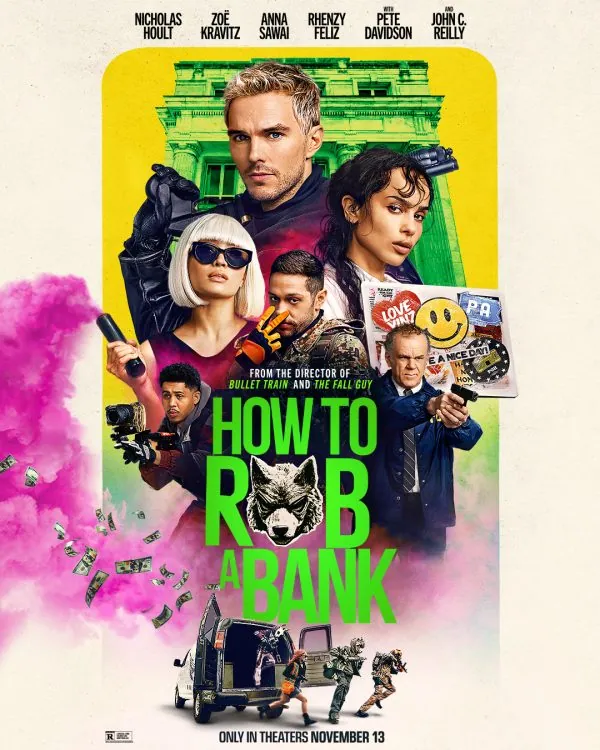
SYNOPSIS:
Bank robbers are posting their heists on social media, causing police to chase them.

It isn’t until almost 90 minutes into director David Leitch’s tonally, structurally, and narratively confused (a trifecta if there ever was one) How to Rob a Bank that there is an attempt to characterize some of the titular thieves stylizing themselves as modern-day Robin Hoods, sporting furry masks as they go about cleaning out vaults while uploading heavily and carefully edited videos to YouTube one by one, detailing guidelines for others to follow suit and get away with it. They also crunch the numbers and show that the odds are in someone’s favor to stabilize this way financially, rather than hoping for karmic justice from doing standard jobs and following the law.
However, at a certain point, there is so little happening meaningfully from a character standpoint that it begins to feel as if screenwriter Mark Bianculli, while trying to have fun, is also indebted to that premise and leaning on it as a crutch that’s only breaking down whatever resonance the movie has or could offer. The bank robbers themselves, led by Nicholas Hoult’s Ryan (who goes by the moniker Big Bad Wolf- I’m sure you can guess which mask he uses) as the mouthpiece for their agenda against corruption and oppression, point out QR codes to take viewers to purchase some of the same equipment they use. It is so unashamedly stylish in this way that you can’t help but wonder whether the QR codes genuinely work if you take out your phone in the theater and scan them (not that I would ever condone such a thing).

Even without that YouTube assault on the senses (containing everything from sound effects to filters and other visual modifications), this is also an eye-rolling film that absolutely needs you to know this group doesn’t just have a moral compass, but are practically angelic criminals; in the opening sequence, one of them is seen handing a pregnant woman a stack of cash and quickly briefing her about explosive dye while assuring her that they mean her no harm. In hindsight, this small detail makes a bit more sense once it becomes clear how much family factors into their motives (because every movie is also about family these days), but it’s still so damn corny. It’s a movie with a premise that should have some dicey moral optics, as all movies about criminals should, but it flattens that into subpar thrills without teeth.
Not even 15 minutes later, another group member remarks to their driver, who’s practicing maneuvers, that this is real life, not Grand Theft Auto. Naturally, as we are on the eve of Grand Theft Auto VI’s hotly anticipated release, it begs the question whether these filmmakers (and Amazon, with the timing of this release) are merely trying to capitalize on that excitement, putting out this somehow mostly personality-free disposable crime drama, under the impression that this is what playing those games entails (for one, I don’t recall ever dressing my character like a furry auditioning for a role in the animated movie series The Bad Guys, which is a far superior IP about criminals with moral compasses).

Jokes aside, the film has jarring whiplash when it suddenly wants viewers to invest in these characters without their masks as it shifts into a more familiar slice of crime drama. Without getting into the details of the finale and the ending, these filmmakers have no clue if they want this film to be defined by outrage, cynicism, optimism, tragedy, heartbreak, or crowd-pleasing. Almost every decision careens into a conflicting creative decision, to the point that not even a reprised Billie Eilish needle-drop elicits emotion.
Whenever that group of bank robbers isn’t on-screen (which also consists of notable actors such as Pete Davidson and others who don’t have much to do aside from eventually trying to manipulate the audience into feeling something), How to Rob a Bank focuses on by-the-book FBI agent West enlisting the help of a house-arrested Reagan (Zoë Kravitz), the developer of an invasive tracking app which has been misused for murder, to join the clichéd hunt. Of course, they don’t see eye to eye about the robbers and their modus operandi, but Reagan relents under the promise of having all charges cleared.
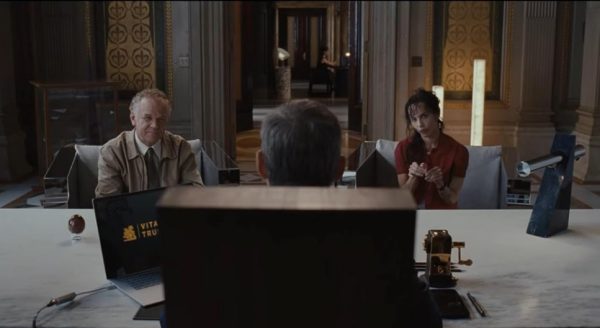
In the aftermath, it’s hard to tell whether these characters have been through such a complicated scenario that they no longer know where they stand on these topics, or whether the filmmakers themselves have no idea. How to Rob a Bank is occasionally worth investing in, with spurts of compelling action (unsurprising given David Leitch at the helm) before becoming obnoxious again, either through narrative incompetence or garish style.
Flickering Myth Rating – Film: ★ ★ / Movie: ★ ★
Robert Kojder