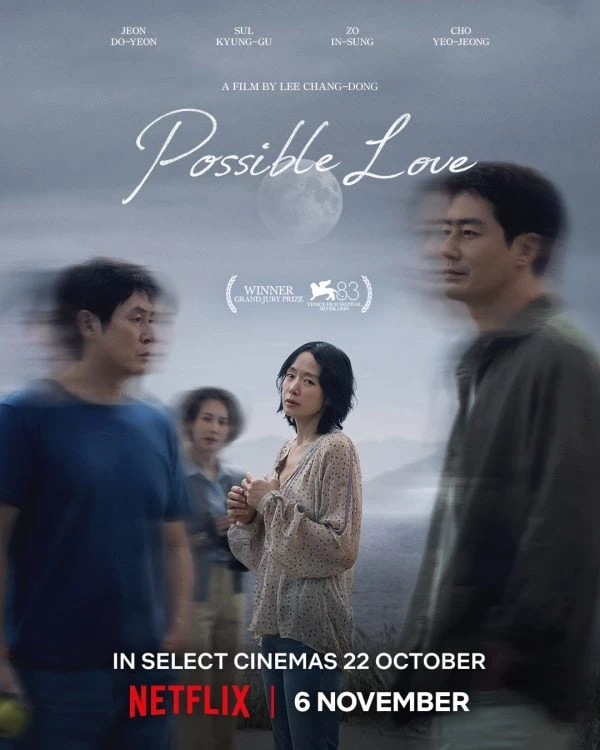
Possible Love, 2026.
Written and Directed by Lee Chang-dong.
Starring Jeon Do-yeon, Sul Kyung-gu, Zo In-sung, Cho Yeo-jeong, Jeong Seop, Jo Yu-ri, Choi Min, Jeon Woon-jong, and Kang Gil-woo.
SYNOPSIS:
A laid-off worker and his wife cross paths with a documentary filmmaker and her spouse and confront their hidden desires.
Some have joked that the title of Lee Chang-dong’s Possible Love (the filmmaker behind the incredible, nuanced class-warfare love triangle Burning) is misleading. That’s also true to a point; this isn’t a romance or a love triangle whatsoever. Rather, with an extraordinary quartet ensemble, it is a dense three-hour story that slowly but steadily sets up and expands character dynamics to a similarly subdued but emotionally harrowing third act, albeit one with revelations and recontextualization, seemingly demonstrating that most topics or actions associated with class and the workforce typically start from a well-intentioned place before turning to rot, sometimes not even through malicious intent. The idea and goal of love through empathy and togetherness are there, but class roles themselves usually blur those lines.
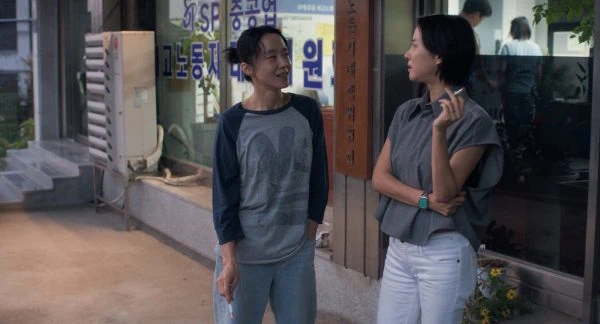
An utterly dejected and depressed family man, Ho-seok (Sul Kyung-gu), is still existentially lost after being let go from his longtime lower-class factory job, unable to work up the willpower to enter therapy no matter how much his supportive wife, Mi-ok (Jeon Do-yeon), sensitively encourages it. At the beginning of the film, he struggles to bring himself out of the car and show his face at a funeral. This is also where they come into contact with privileged and wealthy aspiring documentary filmmaker Yo-ji (Cho Yeo-jeong) and her businessman husband Sang-woo (Zo In-sung), where Mi-ok expresses curiosity and interest in participating in piecing something together, covering these layoffs and an infuriating systemic problem where these companies are restructured by being torn down, only to be sold to American companies.
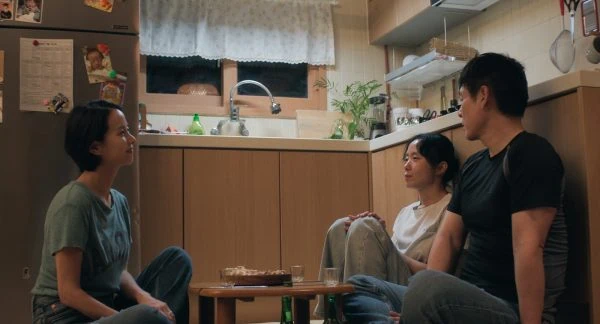
Yo-ji isn’t fascinated by the hot topic of AI and even pulls away from the companies themselves to focus on the human side of the story, using Mi-ok as her subject, with a slim but technically possible chance that her husband will be ready to speak (without spoiling it, there is more to his story than simply being fired). Unspoken friction also surrounds this endeavor; Ho-seok can’t bring himself to participate in therapy yet, and he has every reason to be cautious around a rich woman who wants to document not only the history of his and his wife’s relationship but also their failings and hard-strapped position. Perhaps he will begin to feel emasculated, jealous, or resentful around Sang-woo, who can provide his wife with anything, including the ability to pursue her passions.
For roughly 90 minutes, much of Possible Love follows Yo-ji conducting interviews with Mi-ok, bonding, going as far as inviting her and her young son (a boy who seems adrift and unable to function in the world, either because he has certain needs that aren’t being medically examined or simply because the parents have no time to tend to what he needs and raise a child properly or invest themselves in the activities they sign him up for), with each session becoming more personal. Brilliantly, Lee Chang-dong uses bite-sized flashbacks to give each story a cinematic visual portrait without slipping into excess exposition.
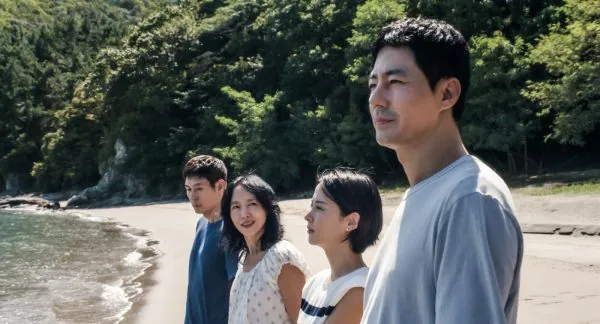
This is also a screenplay-heavy film with the occasional lyrically profound passage, alongside that thoughtful visual language, which means that even when the narrative doesn’t necessarily feel like it’s moving forward, the details of these four characters are always expanding (which is not to say that the pacing is perfect. By the film’s conclusion, it is remarkable how much what could be perceived as throwaway or minor observations feed into bigger moments in the third act. Part of that visual language also involves drastic location shifts to further examine the class divide and how each character reacts to the overall dynamic.
In comparison to what is currently arguably the hottest documentary (and film period), Possible Love also touches on the ethics of documentary filmmaking and perception of people we have nothing in common with, here also serving as an eventual release for Ho-seok’s internal pain (his reaction to another family celebrating their child’s birthday is silently heartbreaking). There is a park near the end where it is somewhat horrifying what Yo-ji seems to think is acceptable to film, who is already sometimes dancing on the line between nobility and exploitation, even if in her heart she just wants to “love these people,” giving us every reason to believe her.
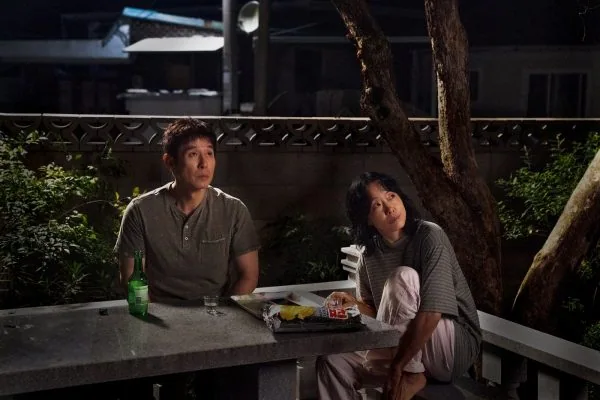
Possible Love is a richly layered work that will only yield more love, appreciation, and insight on a rewatch, but even one viewing will leave you shaken by its scathing points about class, art, and betrayal.
Flickering Myth Rating – Film: ★ ★ ★ ★ / Movie: ★ ★ ★ ★
Robert Kojder