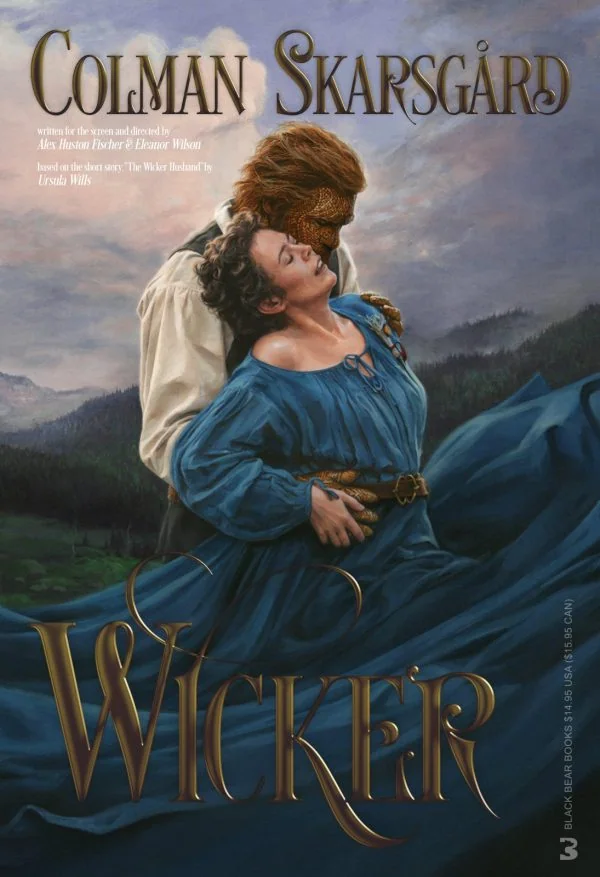
Wicker, 2026.
Written and Directed by Eleanor Wilson and Alex Huston.
Starring Olivia Colman, Alexander Skarsgård, Peter Dinklage, Elizabeth Debicki, Marli Siu, Nabhaan Rizwan, Richard E. Grant, Kiell Smith-Bynoe, Gustav Lindh, Ella Bruccoleri, Ben Ashenden, Phil Daniels, Emily Lloyd-Saini, Scott Alexander Young, Anders Grundberg, and Daniel Bellus.
SYNOPSIS:
An ostracized fisherwoman commissions the local basketmaker to weave her a husband, but when her wicker creation proves unexpectedly extraordinary, his presence ignites jealousy and upheaval that threatens their quiet village.
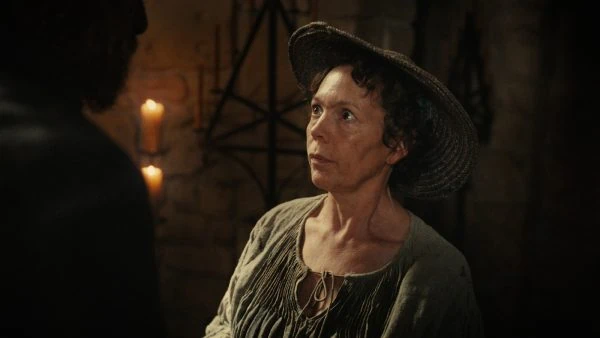
In the fictional seaside village of writers/directors Eleanor Wilson and Alex Huston Fischer’s Wicker women are collared upon marriage and highly subservient to their spouses. Meanwhile, Olivia Colman’s Fisherwoman (all the character names come from their vocations) is perpetually single and routinely insulted for everything from her unkempt appearance to her dirty smell to not being conventionally desirable. Considering how the women are treated, and going along with the gender dynamics on display, although not without moments of questioning the system in place, perhaps it’s for the best that she doesn’t have a man.
Another odd ritual in this village appears to be its version of the ceremonial flower bouquet toss to determine who will be married next, which here involves Peter Dinklage’s Basket Weaver (delightful in the role, twisting his mind into justifying odd jobs through a fascination to create, but also with room to function as a more serious moral compass toward the climax) crafting a basket full of handwoven eggs that explode with different colors of dust, like a cringe spin on a gender reveal party. Much to everyone’s horror, which includes the de facto leader of this village, Elizabeth Debicki’s Tailor’s Wife (more of a mouthpiece for whatever her husband instructs and says), Fisherwoman is inadvertently the lucky winner (or again, maybe not so lucky in this case), which leads her into a prank scheme in which she employs Basket Weaver to make her the perfect man.
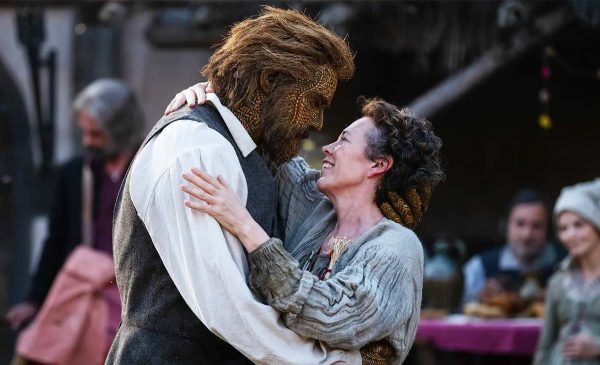
A month later, Alexander Skarsgård’s Wicker Husband (a marvelous accomplishment in makeup and practical effects, not to mention a genuinely evocative performance underneath it all) is delivered and, well, lives up to the wish, whether it be repairing the house or garden work without complaining about the need to do so, or some vigorous sex that is just as much about her pleasure rather than his wants. His calmness is unwavering; he often speaks in a slowed-down dialect while exhibiting seemingly unlimited patience and understanding. Naturally, it isn’t long before the rest of the village’s women notice, which only highlights their husbands’ selfish shortcomings.
This is where the film’s humor can settle into something one-note and obvious in its justifiable skewering of how lazy, complacent, unmotivated, and regressive men can be. It is amusing to realize the story is heading that way, but you also quickly wonder how it will stay fresh and entertaining for the remaining hour. Based on a short story by Ursula Wills-Jones, there is a brief moment of “does this film have anything else to offer,” or is it a story that should have stayed in short form? The answer to that question is bluntly that it does, taking some bizarre turns that further test the skills of the makeup and practical effects teams while exploring insecurity on both sides of the gender equation, but mostly Fisherwoman, as she now has something so perfect after a lifetime of incessant bullying that, as one piece of dialogue puts it, “it’s easier to believe something bad than good”, sometimes without questioning it.
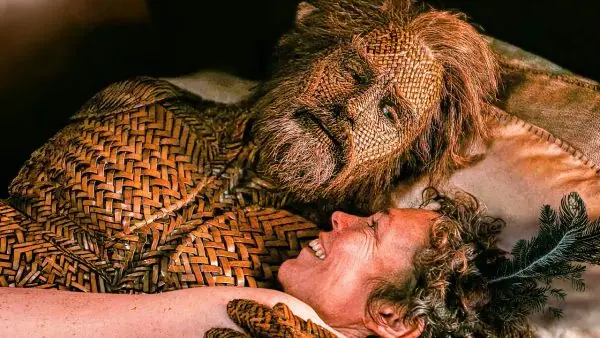
Wicker is certainly a romantic comedy fable, but the filmmakers aren’t interested in placing themselves inside a box, peppering in aspects of thoughtful relationship drama, wicked laughs, a daring tonal balance, body horror, a bit of violence, and by the end, a complete takedown of the values this town stands for. It does this while fleshing out some of the supporting players and giving them arcs, but it’s more about Fisherwoman’s journey of self-discovery and learning to love herself and accept love. Creeping thoughts suggest this love isn’t real, that Wicker Husband was crafted to prioritize her needs over any sense of individuality. Essentially, it’s also a film concerned with what a healthy relationship looks like, with an eccentric sense of humor, distinct designs, and performances that find a grounded humanity amidst the alluring strangeness.
Flickering Myth Rating – Film: ★ ★ ★ / Movie: ★ ★ ★
Robert Kojder