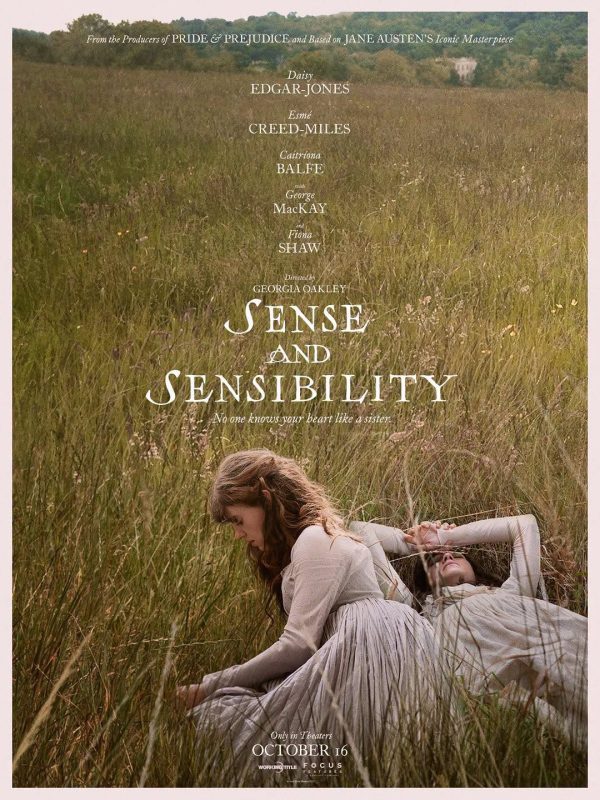
Sense and Sensibility, 2026.
Directed by Georgia Oakley.
Starring Daisy Edgar-Jones, Esmé Creed-Miles, Caitríona Balfe, Bodhi Rae Breathnach, Frank Dillane, George MacKay, Herbert Nordrum, Fiona Shaw, Stacy Martin, Tom Brooke, Chloe Pirrie, Forrest Bothwell, Bethany Slater, Eliot Sumner, Ceara Coveney, Turlough Convery, Sophie McGibbon, Charlie Varlet, and Paulie Bovingdon.
SYNOPSIS:
A story of love, family, and sisterhood based on Jane Austen’s Sense and Sensibility.
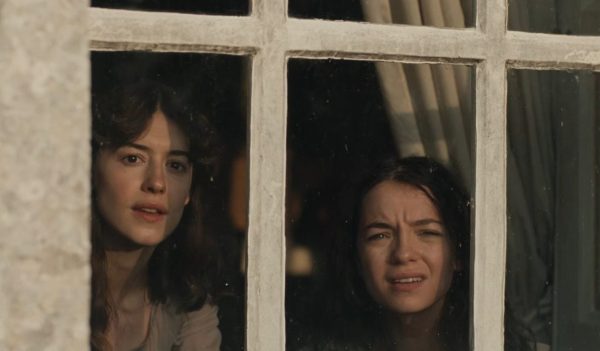
As someone loosely familiar with Sense and Sensibility (an understanding of the major plot points in Jane Austen’s debut novel and a vague memory of at least one adaptation featuring Kate Winslet), what sticks out most while watching director Georgia Oakley’s stab is that it’s, more or less, a highly faithful take on the material that, while gorgeously shot and crafted, doesn’t have much authorship. Aside from the occasional modern touch in the dialogue (though it’s always clear when lines are taken directly from Jane Austen’s romantic, witty writing), the main addition is an insignificant quickdraw duel toward the end.
Essentially, it’s more sense than sensibility, with the only passion coming from seemingly ensuring all the narrative adaptation boxes are checked, with striking photography and serviceable period-piece costume design. Beyond that, the film never makes it clear what, specifically, the filmmaker (working from a screenplay by Diana Reid) is fervent about in this classic piece of literature. Despite those admirable qualities, it’s not a definitive enough execution to offset what feels like going through the motions, even with some impressive performances throughout.

The story follows the Dashwoods as they relocate after the tragic death of the matriarch’s (Caitríona Balfe) husband, with her three daughters of different ages, all of whom seek love while pursuing their own definition and language of it. Elinor (Daisy Edgar-Jones) seeks a more practical form of love, while her younger sister Marianne (Esmé Creed-Miles) embraces passion and boldness without hiding her feelings. Their teenage sibling Margaret (Bodhi Rae Breathnach) is more excited by the idea of marrying rich than by love, which the film occasionally plays for laughs at the expense of the amusingly ambitious dreams often found in youth.
As a result, the older sisters eventually clash, unsure what they should and shouldn’t say about their ongoing dating/matchmaking (it is noteworthy watching this in the generation of Tinder, struck by how much of the connections here feel like an in-person depiction of the pros and cons of those apps) lives or how to help each other cope when things go sideways. The characters are more mouthpieces for love languages than fully formed people to rally behind, and the sheer number of supporting players only makes it too crowded. Even at a little over two hours, everyone and everything here feels underdeveloped, once again, as if it’s more about fitting in all the cliffnotes of the novel.

There isn’t so much character development here as alterations, with one side coming to understand the other, or sometimes demonstrating the exact opposite behavior. Perhaps someone reserved and quiet is burning with more love than anyone realizes, while someone brazen and loud about their feelings might be putting on a deceitful show. That’s one way of saying there are different manners of heartbreak here when suitors Edward Ferrars (George MacKay), Colonel Brandon (Herbert Nordrum), and Willoughby (Frank Dillane) enter the story, coming across more as chess pieces moved around a board.
And yet the performances are all filled with sincere yearning, mopey devastation, a believable pitch of sentimentality, joy, a moving portrait of sisterhood, and stark juxtapositions between the titular characteristics, with more than enough admirable effort put into the below-the-line crafts that it’s also unfair to necessarily say the film isn’t good. Toward the end, it even musters some real emotion alongside swelling musical cues. During outdoor moments of shock and sad disbelief, the camera shakes like a Paul Greengrass action scene, while remaining completely fixed and still in scenes of clarity, politeness, and logistics, creating a thoughtful visual distinction between sense and sensibility.

It also can’t shake the sense that it’s too faithful and uninterested in putting a spin on the material. Sense and Sensibility is a well-crafted, stirringly performed adaptation that lacks passion and real depth; it’s competently put together but offers little purpose or a refreshing approach. This is for the Jane Austen diehards, but even they might be disappointed that it’s a paint-by-numbers, merely solid adaptation.
Flickering Myth Rating – Film: ★ ★ ★ / Movie: ★ ★ ★
Robert Kojder