Whalefall, 2026.
Directed by Brian Duffield
Starring Austin Abrams, Josh Brolin, Elisabeth Shue, John Ortiz, Jane Levy, and Emily Rudd.
SYNOPSIS:
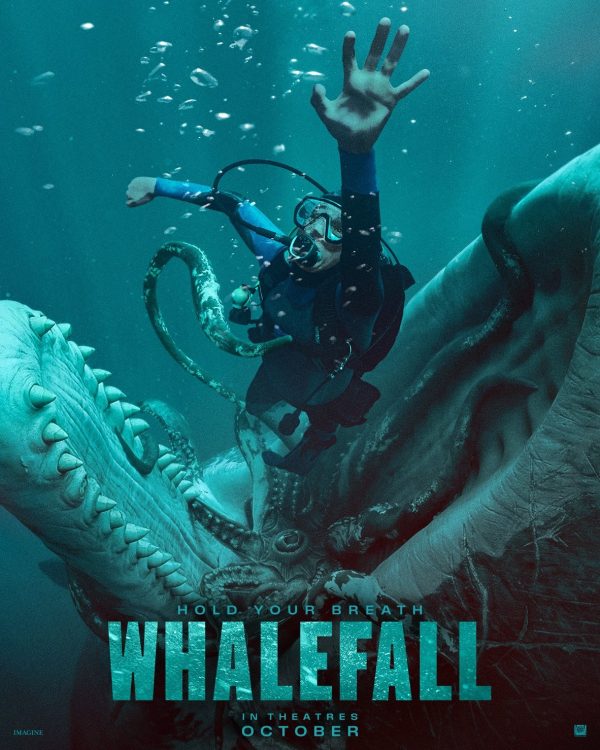
Following the death of his father, Jay Gardiner (Austin Abrams) goes diving off the central Coast of California in search of his remains, but is swallowed by a massive sperm whale.

American author Kurt Vonnegut famously said that all stories share a limited number of basic plots, one of which was ‘Man in a Hole’, also referred to as ‘fall-rise’. Well, that almost applies to No One Will Save You director Brian Duffield’s Whalefall, in which Austin Abrams hardly takes a breath after being put through the wringer in Resident Evil to become ‘Man in a Whale’, falling and rising multiple times as he attempts to find a way out of the pulsating innards of a leviathan.
Adapted from his own best-selling novel, Daniel Kraus keeps things simple with a two-strand narrative that jumps between the present day, in which Abrams’ Jay returns home for the first time since the death of his father (Josh Brolin), and moments from his past that underline their fractious father-son relationship.

Josh Brolin plays Mitt Gardiner as a stubborn, cruel man, so obsessed with being at one with nature that he is unable to be at one with his own son. Habitually belittling Jay for his perceived weaknesses, tiny lung capacity (great foreshadowing there), or just wanting to hang out with his friends on their birthday. Although a trip to Ocean World does feel like Jay baiting his old man, but only adds to the dynamic that this two people simply don’t get on.
Back to the present and Jay is sneaking off at the crack of dawn with his oxygen tank to perform one final ‘f*ck you’ to his father by diving out to his watery resting spot. While down amongst the inquisitive fish and rhythmic dancing of the seaweed, his gloomy tranquillity is disturbed by a 50,000 Leagues Under the Sea-sized squid, but it’s what following that’s the problem, and also the reason you’ve bought a ticket. And so Jay joins Jonah, Pinocchio, and Kipling’s The Shipwrecked Mariner in being swallowed by a whale, and he has the time it takes for his oxygen to run out to escape.
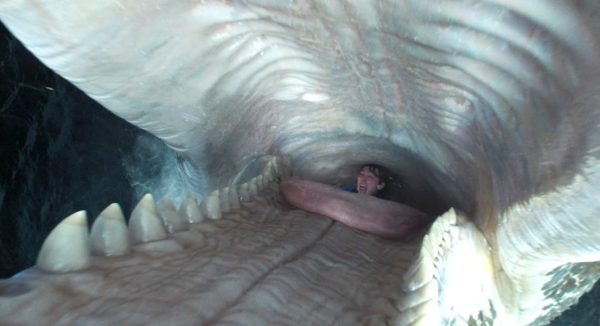
The key to preventing Whalefall from going belly-up rests squarely on the shoulders of Austin Abrams. As with most single-setting survival films – 127 Hours, Buried, The Martian – it’s imperative that you care about the person trapped in their particular set of circumstances. Jay feels bruised before he’s even in the belly of the whale. Quiet, full of repressed emotions, and distant. He’s a product of years of oppression from a man who he simply wanted fatherly validation from. So when you see him suffering further in this most horrific of chambers of death, you’re immediately invested beyond the gimmick of it being about a man-in-a-whale.
Abrams runs the same gamut that he did in Resident Evil, even employing that squeal he used to comedic effect in Raccoon City, yet here it feels more real, more visceral. It’s testament to the breakout star that he’s able to command the screen on his own, or with the assistance of a cute jellyfish to rival Wilson in the survival sidekicks stakes. He has a real gift for making those talk-to-yourself monologues feel genuine, rather than a necessary narrative device for the movie, and that pays off in spades towards Whalefall‘s finale.
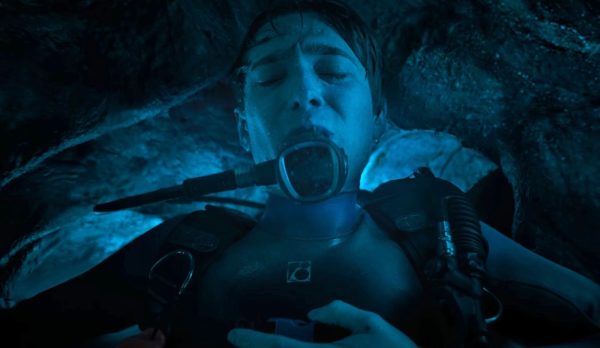
Essentially a two-hander, well three if you count the Sperm Whale, Brolin’s performance is requisitely broad. The scenes between the two bristle, with the veteran actor tapping into the same gruff pig-headedness he employed in The Dog Stars, but his performance is key in where Duffield wants to drive the story.
On the director, he shoots the hell out of this. Colour is so important in telling this story; the drab filter that hangs over the mourning family, contrasting with the bright flashbacks . Yet that’s nothing compared to when you’re in the belly of the whale. Structured like Dante’s circles of hell meets the worst Crystal Maze game you can imagine, it’s disgusting and beautiful at the same time. Flesh pulses, sparks of light streak through the walls of the beasts stomach lining, and each compartment of the whale’s body appears to have its own colour scheme. It’s so well realised that you can almost smell the noxious gasses emanating from the pools of ooze and juice that Jay has to swim through. If you can find Whalefall in 4DX, those of a delicate disposition might want to stay on dry land.
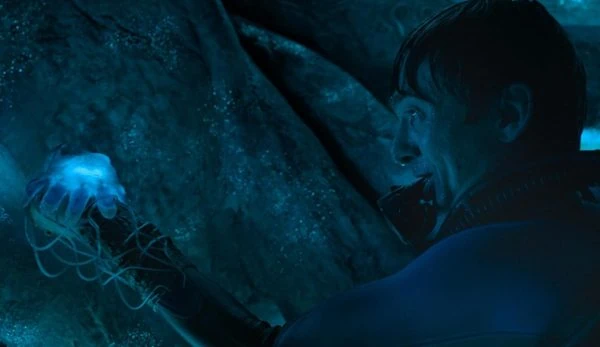
Half the fun is the ride, so to reveal too much of what Jay goes through in the guts of the whale would be a dereliction of duty, but sufficed to say that it’s bone-crunching, tension riddled, and often agonising to tolerate, so-much-so that the occasional fade-to-black is welcome relief.
There is a big third act swing that’s a natural evolution of the story that’s being told here, and in the context of Jay facing his own death, it makes complete sense. However, some might not be so willing to accept the tonal shift, instead expecting something akin to Jason Statham surfing the dorsal fin of a Megalodon. This isn’t that movie, it’s something a lot more meditative and human, and your experience and the film are better for it.
Like a messed up aquatic Inner Space, Whalefall is guts, slime, and a bloody great time. It’s more than just a man-in-a-whale movie though, with the entire thing buoyed by an emotional core that’ll make you blubber.
Flickering Myth Rating – Film ★ ★ ★ ★ / Movie ★ ★ ★ ★
Matt Rodgers – Follow me on Twitter