Fatherland, 2026.
Directed by Paweł Pawlikowski.
Starring Sandra Hüller, Hanns Zischler, August Diehl, Anna Madeley, Devid Striesow, David Menkin, Joachim Meyerhoff, Enno Trebs, Theo Trebs, Waldemar Kobus, Daniel Wagner, Fritzi Haberlandt, Milan Peschel, Joanna Kulig, Christophe Falconnet, David L. Price, and Bernd Moss.

SYNOPSIS:
In 1949, German writer Thomas Mann and his daughter Erika embark on a road trip across a Germany in ruins, from US-dominated Frankfurt to Soviet-controlled Weimar.

No one frames a monochromatic post-World War II film quite like co-writer/director Paweł Pawlikowski and regular collaborating cinematographer Łukasz Żal, and that duo once again delivers in Fatherland, which could be taken as in conversation with Ida and Cold War given the themes and a similarly scant running time (if you exclude production company logos and the ending credits, this movie generously barely cracks an hour).
In this case, the film begins with a phone call complicating the motions between siblings Erika (Sandra Hüller) and Klaus (August Diehl), children of celebrated novelist Thomas Mann (Hanns Zischler), who infamously fled Germany before the war and the Nazi Party fully took over the country, shot in one take with striking blocking as the latter sits on the floor perpendicular to the bed, discussing that their father will be returning to the homeland to accept the Goethe Prize, which is still given out every three years today and generally goes to impactful artists. Whether Klaus will join this two-faced tour, where their father will be a guest of honor and give philosophical speeches to pretenders who despise him for abandoning the party, is a quietly tense conversation that will hang over the rest of the film.

The other element of filmmaking Paweł Pawlikowski (writing the screenplay alongside Hendrik Handloegten) has mastered is condensing a narrative that might otherwise run two hours in someone else’s hands, and stripping it down to scenes of loaded importance. Touring a 1949 Germany separated between capitalism and socialism, US and Soviet-controlled, the weary Thomas makes grand statements about those systems, how the country should move forward, and art to rooms of people who will smile and clap, and in the next moment, typically in the scene with Erika, reveal themselves to still be stains on society, such as an ex-husband who sold his soul to the Nazi Party to be the biggest actor during that time.
Several of these one-appearance scenes have either Thomas or Erika talking to someone of historical and cultural significance, making a lasting impression but without the full-scope context someone might want. Those with vast knowledge of these individuals and this era will simply find more depth in such short, limited exchanges. Instead, what little story and emotion are here (it is a cold film otherwise, which could be taken as in tandem with Thomas’ conflictions about what he is doing here in a place that doesn’t feel like home and hasn’t been home for over a decade) come from eventually directly talking about an ongoing family tragedy, and Erika calling her father out on the absurdity of this celebration with harsh truths, scolding him that nothing he says will actually change anything.
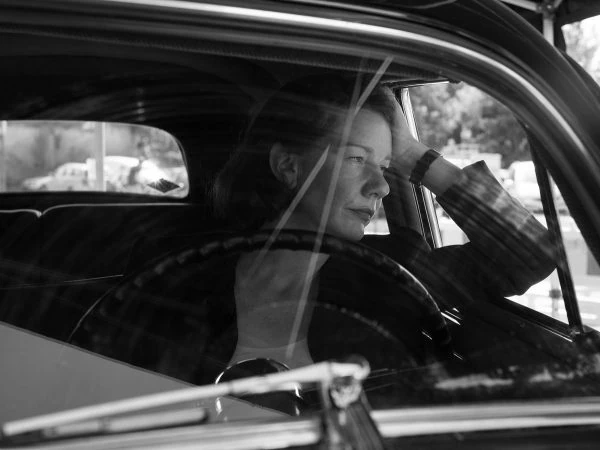
Yet despite the restrained but absorbing performances from the family trio (with Hanns Zischler in particular having an incredibly expressive moment toward the end, a burst of emotions that can no longer be contained inside) and sublime photography, Fatherland feels somewhat incomplete, and certainly abrupt in its ending. It leaves one wanting a little more, even though the film has already provided much to ponder and explore further. In some ways, it also almost feels prophetic that America will soon be in the same position.
SEE ALSO: 2026: The Year of Sandra Hüller
Flickering Myth Rating – Film: ★ ★ ★ / Movie: ★ ★ ★
Robert Kojder