Tom Jolliffe continues our series of director beginner’s guides with Andrei Tarkovsky…

Some directors have an important impact on cinema. It doesn’t always tie in with box office results, or widespread audience appeal. If you’re in the States or the UK, chances are your predominant cinematic experience revolves around American or British films. As far as worldwide spread, American cinema in particular has the most far reaching impact.
You’ll notice, if you’re lucky enough to have a physical media store left in your vicinity (HMV in the UK remains one of the last bastions of high street film shopping) that sub-sections like Anime etc. are confined to smaller units. Even smaller than those (because Anime for example has such a general cult appeal) is normally (but in some cases, not) a ‘World Cinema’ section. This is where you will find a selection of world cinema which managed to impact on the rest of the world. You’ll probably find Amelie there, Hero, and Downfall for example.
Andrei Tarkovsky, the great Russian director, comes from a cinema known for artistic experimentation, expression and often a disposition toward the bleak. From Europe, you often think of iconic French, Italian, German and Swedish directors. You also think of Soviet directors, going back to the likes of Sergei Eisenstein. By the time Eisentsein was closing his career, Andrei Tarkovsky was starting. Certain censorship restrictions would frustrate him until an inevitable move further West (and North) into Europe (he made an Italian film and a Swedish film to see out his career before his untimely death). A total of only 7 finished feature films means that in principal, Tarkovsky is a director fairly easy to get into and cover. This isn’t entirely the case.
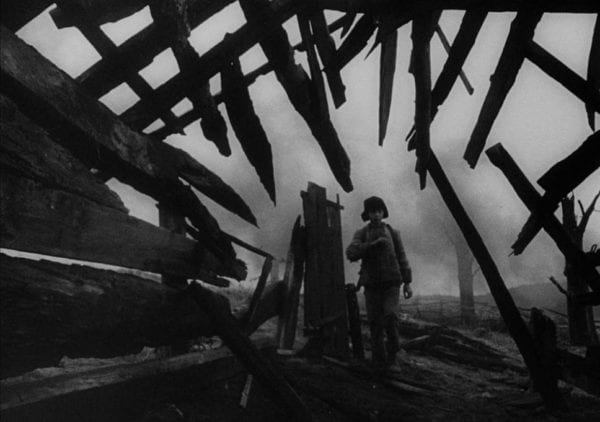
On the basis of first films being ideal start off points (not always the case, if you’re revisiting James Cameron say), the natural starting point for Tarkovsky would be Ivan’s Childhood. In many ways, it’s his most accessible. For one, it’s short (his films predominately venture comfortably past 2 hours). It’s relatively quick paced compared to his others too. What it puts out there is common strands that will follow through his films. Dreams play an important part. Fantasy. Sometimes the idea of fantasy infiltrates and affects memories. We see this in Ivan’s Childhood, a war film from the eyes of 12 year old Ivan who serves as a scout behind German lines. His films also generally include a lot of religious imagery and allegory too. Another strand comes from Tarkovsky’s background in photography. He saw film as not needing to have montage, or intricately weaved storytelling as a prerequisite. His goal was always to emotionally engage. Not necessarily entirely through the characters and stories, but in the way he shot and cut the films. He wanted his audience to feel the film, to feel some emotional pull to the visual aesthetics of whatever he shot.
Tarkovsky would shoot sequences very deliberately, with great attention to detail as far as framing and blocking a scene. Likewise he was a great proponent of using all the natural elements to add a level of texture to the frame which you could almost feel and touch. Fire, water, Earth, Wind. Sometimes all in a single shot. There’s never a dull or a flat frame in Tarkovsky’s films. It’s not style over substance by any means, because he invites the audience to instil on a film whatever they wish to bring to it. Many a cinephile has picked apart his films wishing to uncover Tarkovsky’s hidden messages, or symbolism, but he didn’t always implicitly place them in there. He just wanted the audience emotionally invested in an audio/visual experience, encouraging them, with often serenely quiet stretches, considered pacing and long one shots to invest time and attention. Never would Tarkovsky resort to slapping the audience in the face with elaborate camera work or frantic editing. You’re almost, as a film-maker resting on certain crutches (granted, well tried and tested in modern cinema) to keep the attention of the audience. An example of that would be Michael Bay films for instance. Frantic cuts, superfluous camera work and relentless pyrotechnics. It’s not so much asking an audience to give their attention, but forcefully mugging them of it.
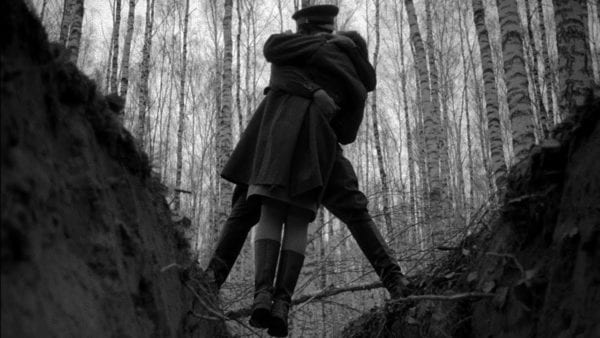
Ivan’s Childhood is a harrowing but beautiful coming of age tale that wonderfully captures youthful exuberance and fantastical whimsy, and throws it into the horror of war. Like every Tarkovsky film, it is beyond simply being film. It’s a work of art that will enrapture and haunt you, if you give yourself over to it. Like his other films, whilst it would come under (to some) the dreaded ‘subtitles’ label, it’s so light on dialogue, and often so visually orientated that it plays almost like a silent film. For long stretches not a word is spoken. Again, Tarkovsky almost always favoured show over tell, and it is in that evocative linger of his camera that invites so much theorising and analysis about his works. Somehow even in what would ordinarily be simple shots, he managed to make them stunning. You may not have seen the film, but if you’ve ever seen compilation videos of beautiful cinema shots, chances are you’ll have seen iconic shots from Ivan’s Childhood (such as ‘The Kiss’).
Click below to continue on to the second page…
Originally published December 11, 2018. Updated July 19, 2024.