Masters of the Universe, 2026.
Directed by Travis Knight.
Starring Nicholas Galitzine, Camila Mendes, Alison Brie, James Purefoy, Morena Baccarin, Jóhannes Haukur Jóhannesson, Kristen Wiig, Jared Leto, Idris Elba, Sam C. Wilson, Hafþór Júlíus Björnsson, Kojo Attah, Charlotte Riley, Dolph Lundgren, Sasheer Zamata, Jon Xue Zhang, Christian Vunipola, Arun Bassi, Artie Wilkinson-Hunt, Eire Farrell, Christiaan Bettridge, James Wilkinson, Hung Dante Dong, James Apps, Max Kraus, Kelly Coughlin, Elena Rivers, Stephen Adentan, Delilah O’Riordan, Christopher Ragland, Gary Martin, Fletcher Glenn, and Tom Wilton.
SYNOPSIS:
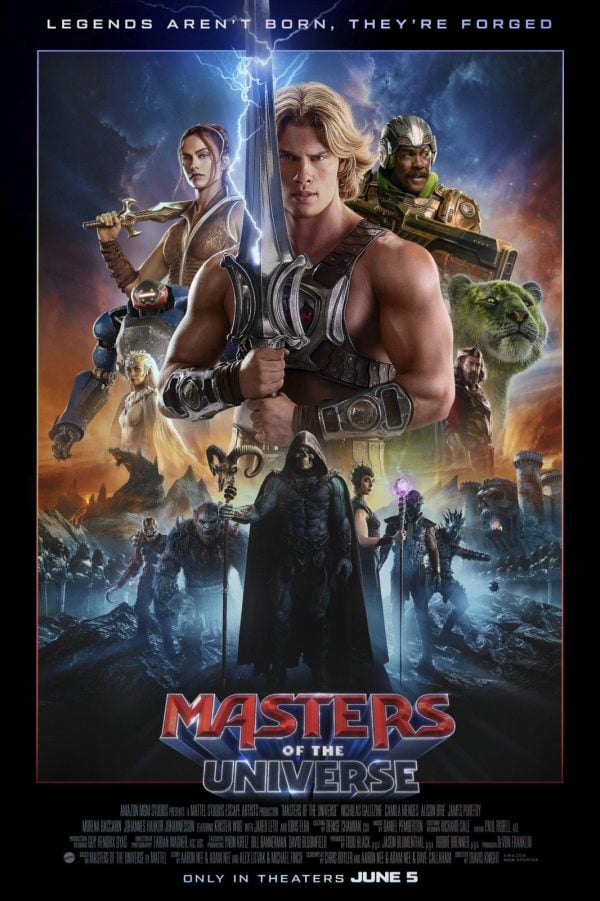
A young man on Earth discovers a fabulous secret legacy as the prince of an alien planet, and must recover a magic sword and return home to protect his kingdom.

Whether it’s working in animation or live-action properties based on popular toys, director Travis Knight seems to be aware that these adaptations require a tightrope-walk between genuine affection for the source material (either through the characters or storylines from other spins such as cartoons), a winking acknowledgement with humor that all of this is wacky and should not be taken remotely seriously, heart, and a commitment to building real sets (Guy Hendrix Dyas) and utilizing practical effects, costumes, and makeup in a cinematic blockbuster landscape that is far too quick to cut corners through excessive CGI and green screen to the point that such spectacle no longer carries weight or impact. Bluntly put, Masters of the Universe is refreshing; a bona fide ” they rarely make them like this anymore” popcorn flick, even if it’s undeniably flawed.
Perhaps the strongest example of this tone balance handled correctly comes from Jared Leto’s performance as the skull-faced Skeletor, essentially Adam Glenn/He-Man’s nemesis, certainly menacing through a ghoulish voice and dastardly actions, with the filmmakers (the screenplay comes courtesy of Chris Butler, Aaron Nee, Adam Nee, and David Callaham, with story credits also attributed to Michael Finch and Alex Litvak) smartly unafraid to flip that characterization like a switch into pathetic whininess.

The filmmaking team also wisely has no ambition to make this narrative or its antagonist too deep; sometimes a villain is just a villain, and a guy with a skull for a face doesn’t have any complex motivations for taking over and ruling a fantastical world. Also amusing are the moments when his right hand, evil sorceress Evil-Lyn (Alison Brie), appears attracted to the cruelty he inflicts, while often bumbling her way through hyping up his evil reputation. They are not only a pair in sync with one another in veering between the imposing and the incompetent, but also with the film’s wildly inconsistent tone, which typically knows when to lighten the mood before things get too dark, tragic, or heavy.
There is also a clever touch in that the flashback prologue – which takes place on the fantasy planet Eternia when 10-year-old Prince Adam (Artie Wilkinson-Hunt) is a weakling runt incapable of learning proper battle techniques or how to defend himself despite copious amounts of training from Royal Army General Duncan (Idris Elba), and a desire to make his concerned father, King Randor (James Purefoy) proud – depicting the downfall of the realm and it’s fall into the nefarious clutches of Skeletor, is mostly played for drama and stakes, allowing for some emotional investment before pulling back the curtain at a perfectly timed moment to funnily reveal that, fifteen years later on Earth, Adam (now played by Nicholas Galitzine) is reciting this story of his home world to a date who is now understandably freaked out and forward about wanting to leave.

Working in human resources, Adam is rather skilled at his job and lending an ear to others, fully believing that most situations can be worked out through talking (something he actually tries to do with Skeletor as part of the film is about knowing when to fight and defend oneself and when not to), although it doesn’t stop him from desperately putting out online notices seeking the Sword of Power, which ended up on Earth before Skeletor could wield it and possess the power of a god. Fret not, little of the film actually takes place on Earth, as Adam is directed to the sword, which also leads him to a reunion with his childhood crush, Teela (Camila Mendes in the present day and Eire Farrell in the opening flashback sequence), and a ride back to Eternia for more reconnections and a battle for the fate of the world against Skeletor and his army.
This intentionally goofy story serves to teach Adam that simply wielding the Sword of Power (which also transforms him into the traditional He-Man attire) isn’t what makes someone a man fit to save a kingdom or win over a secret love, even if it does grant him enhanced abilities. He is given a hero-treatment wish-fulfillment fantasy of a life that everyone on Earth believes is just that (even considering he hasn’t done anything special there, either), delivering the message that what someone does with that power granted is far more important than having the power itself. Adam also gets to fight along fantastical soldiers he admired growing up, ranging from a neck-stretcher to a human battering ram to another with a giant fist, a gallery of characters that the film knows are absurd and has fun pointing out; “Give em head!” the “fister” says to the ram. Duncan, now a disgraced drunk, also has a thing or two to learn about heroism, with a character arc that works in tandem with Adam’s.

At one point on Earth, it is suggested by Adam’s boss that his recollection of his time on Eternia is a coping mechanism for traumatically losing his parents (who may or may not still be alive), which is a tantalizing element that a far superior film would continuously pull on more. The idea that all of this is real and we are witnessing a He-Man origin story is obviously an easier pill to swallow and takes away from what could have been an exceptionally dizzying mind-bender, using that fantasy world to its advantage to perhaps also say something about nostalgia and societal norms surrounding perceptions of masculinity during that era in relation to modern times. Thankfully, Masters of the Universe still has something to say about masculinity, though in a watered-down form presumably to ensure the narrative has broader appeal (then again, given the box office projections, there might be no such thing for this movie).
That parenthetical observation is unfortunate, as even when one takes away from what Masters of the Universe is about, who it is for, and who will care, or that some of the comedy just isn’t funny, this is some sturdy and nicely choreographed action filmmaking with charm and rewarding effort in the production design. The simple fact that there are real sets built for Eternia, with dozens and dozens of extras in costumes for Adam to dismantle across well-crafted battle scenes makes all the difference. It is something that filmmakers should by now realize goes a long way toward giving a film a sense of tangibility and weight, something that offsets the corniness of the drama and grounds it in sincerity and earnestness worth investing in. By the power of Amazon, the money was well spent here, resulting in a rousing adventure centered on where strength comes from, that benefits from a rockingly majestic score by Daniel Pemberton (one of the best composers working today) and embracing goofiness.
Flickering Myth Rating – Film: ★ ★ ★ / Movie: ★ ★ ★
Robert Kojder