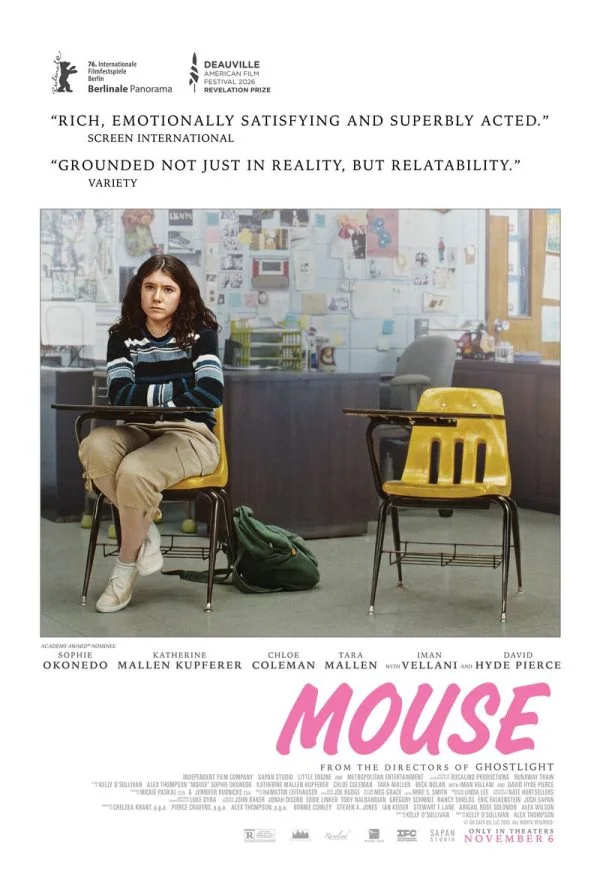
Mouse, 2026.
Written and Directed by Kelly O’Sullivan and Alex Thompson.
Starring Sophie Okonedo, Katherine Mallen Kupferer, Chloe Coleman, David Hyde Pierce, Tara Mallen, Iman Vellani, Beck Nolan, Addisyn Grace Cain, Audrey Grace Marshall, Christopher R Ellis, Mary Kathryn Bryant, Barry Clifton, Raeden Greer, Mary Hollis Inboden, and Abigail Rose Solomon.
SYNOPSIS:
In 2002, best friends Minnie and Callie’s relationship is upended on the eve of their senior year.
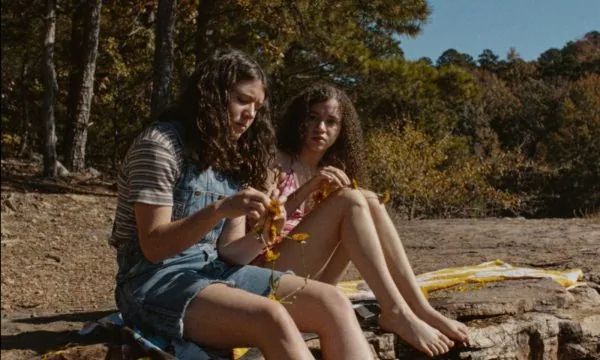
With Mouse, Kelly O’Sullivan and Alex Thompson have cemented themselves as master storytellers of grief. Retaining two stars from their previous work on the theme, Ghostlight, and set this time in Arkansas in 2002, Katherine Mallen Kupferer plays introverted Minnie Dunn, earning the on-the-nose nickname Mouse. What separates this film from other stories about grieving is that there is also a class aspect woven into the fabric, as Katherine’s real-life mother, Tara Mallen (the other half of that reunion), fittingly plays her mom Barbara, a no-filter single parent with a pigsty of a home filled up with rescue pets. It’s clear that she loves her daughter, but between working at a veterinary clinic, juggling other responsibilities, and simply not always knowing how to talk to her daughter without embarrassing her, she isn’t necessarily the most attentive mom compared to popular best friend Callie (Chloe Coleman), who is routinely doted on by her mom Helen (Sophie Okonedo), classier and more cultured, with more financial stability in the family.
Keeping spoilers to a minimum, a wrench is thrown into their friendship during summer vacation between junior and senior year, amplifying every one of Minnie’s personal frustrations and emotions. Naturally, she doesn’t like being the quiet one other friends in their circle sometimes forget exists. It’s also hard to live in the shadow of a theatrically talented friend with genuine promise and plausible dreams, only to have yet to discover a single talent; the intriguing part is that, in real life, Katherine Mallen Kupferer has performed on stage. Meanwhile, Helen’s properness and thoughtfulness – including giving her daughter Callie vocal lessons- add another layer to why she starts spending more time at their home. It’s a bit like that saying “the grass is greener on the other side”, although not necessarily, and perhaps just different.
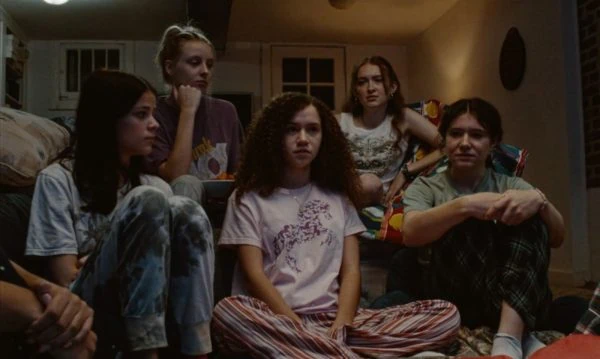
As for the friction between Minnie and her mom, even if one doesn’t know the same dynamic is true for the actors, it has a naturalism that is almost impossible to replicate otherwise. Every small gesture between them feels authentic and, beyond that, as if they’re taking elements of their own relationship and transferring them to these characters. When Barbara throws her hands up in frustration and wisecracks, “If you have kids, you will spend half your time chasing after them,” it feels less like written dialogue and more like a spur-of-the-moment delivery riffing on an already shared bond.
Amidst all of this, Minnie also leans into her sexuality, befriending video store worker Kat (Iman Vellani), which isn’t played with the usual clichés or valid concerns about fear of coming out, but rather as an extension of her awkwardness. It’s also a beautifully understated part of moving on from her friendship with Callie.
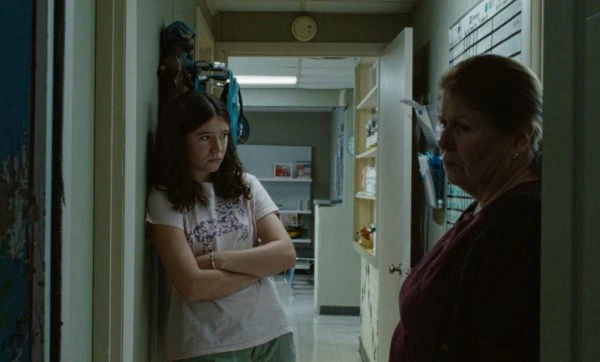
At school, the upcoming talent show has a theme that won’t be spoiled, but it also plays on the lost friendship. Even when the film comes close to turning some of Minnie and Callie’s peers into one-note, self-absorbed antagonists with a woefully misguided idea, Kelly O’Sullivan and Alex Thompson never lose sight of the fact that the girls are still human and grieving, meaning well, and turning that into an unexpectedly moving moment accentuated by a superb song choice. There are needle drops here, and at least one repeats throughout the film for emotional impact (you might also start crying every time you hear a certain Michelle Branch song after watching this), but it’s never about reaching into a vault of obvious choices; it’s always about what best serves the story.
Then there is the growing bond between Minnie and Helen, where one might expect some familiarity in the narrative. However, these filmmakers are intelligent screenwriters who always know how to pull back and stay focused on the complexities of the character dynamics. They do this with smaller supporting characters, who are also grieving and given time to show that, and to be confused and complicated humans (such as Callie’s ex-boyfriend breaking down in a car while talking with Minnie).
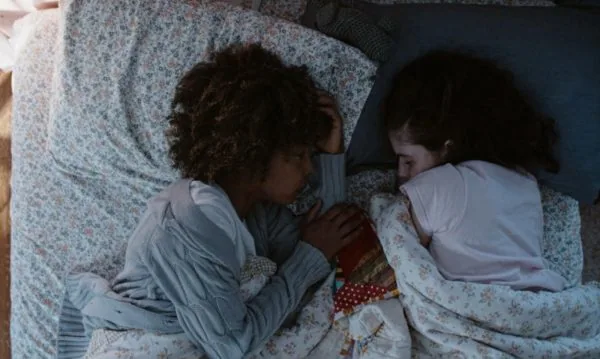
Nevertheless, Minnie, despite not having a singing voice, is determined to be a part of the talent show honoring her friend, to the degree of being coached with lessons by Helen, blurring all sorts of lines between who and what they are to each other, what each of them wants from one another, and whether or not Tara is losing her grip on her daughter. The emotions that surface throughout Mouse are overwhelming, devastatingly complex, and undeniably real, with a character study expanded far beyond the grieving process.
Flickering Myth Rating – Film: ★ ★ ★ ★ ★ / Movie: ★ ★ ★ ★
Robert Kojder