On the 30th anniversary of its release, Hasitha Fernando revisits The Ghost and the Darkness…

The Ghost and the Darkness is a suspenseful historical adventure set in East Africa in 1896, which recounts the story of the man-eaters of Tsavo, who wreaked terror on a railway bridge site of that region. The film’s production was a famously troubled one with challenges posed by local wildlife, unplanned script changes and major re-edits to the final cut of the movie. As the film celebrates its 30th anniversary we look back at the lengthy journey from the book to the big screen and the behind-the-scenes drama that took place in between…
The story was pitched to the studio as a cross between Jaws and Lawrence of Arabia

The Ghost and the Darkness was an adaptation of Lieutenant- Colonel John Henry Patterson’s semi-autobiographical book The Man-Eaters of Tsavo. Published in 1907, it recounted Patterson’s experiences with a pair of man-eating lions whilst he supervised construction of a railroad bridge over the river Tsavo in Kenya. The events that transpired in Tsavo and documented in his book has been the subject of much debate over the years, but that hasn’t stopped Hollywood from using it as a source material for multiple films as evidenced by 1952’s Bwana Devil and 1959’s Killers of Kilimanjaro. William Goldman, the talented screenwriter behind such films as Butch Cassidy and the Sundance Kid, All the President’s Men, The Princess Bride and Marathon Man, first heard about Patterson’s story when he was vacationing in Africa in 1984 and thought the premise would make a fine script. Goldman pitched the story to Paramount in 1989, as a cross between Jaws and Lawrence of Arabia and the studio immediately commissioned him to write a screenplay, which he completed by 1990. Regarding the two man-eating lions Goldman had this to say, “My particular feeling is that they were evil. I believe that for nine months, evil popped out of the ground at Tsavo.”
Many changes were made to Patterson’s account when writing the script

Although the intro-narration says that it is a “true story”, Goldman took many liberties with Patterson’s story when he adapted the source material. One of the main changes he made was the introduction of an American big-game hunter named Charles Remington. The character was based on one Charles H. Ryall, who was an Anglo-Indian big-game hunter and superintendent of the Railway Police. In older drafts of the screenplay, the character went by the name of Redbeard and according to Goldman, his purpose was to craft an imposing character who would subsequently be killed by the lions and in order to make Patterson seem more brave. Another detail that wasn’t included in Goldman’s script was Patterson shifting the location of the bridge building elsewhere as the original place was deemed too sandy.
The project was stuck in development hell for the longest time

Although Goldman turned in his script in 1990 the production was mired in development hell and innumerable delays before it saw itself off the ground. Paramount Pictures originally wanted Michael Mann to direct but after negotiations fell through the studio approached Kenneth Branagh to helm the effort following the success of 1989’s Henry V. Somewhere in the early 1990s, filmmaker Brian De Palma was chosen to direct with Kevin Costner attached to star as Patterson after Tom Cruise turned down the role. After the colossal box-office misfire of The Bonfire of the Vanities, however, Paramount grew cold feet and withdrew their offer to De Palma. Costner too departed the project and went on to make The Bodyguard. Production was stuck in the doldrums for several years and things turned around only when Michael Douglas moved his fledgling production company Constellation Films to Paramount and came across Goldman’s script. Douglas was impressed by what he read, calling it “an incredible thriller about events that actually took place” and decided to produce the effort. Up-and-coming director Stephen Hopkins who helmed Predator 2 was hired to direct.
Val Kilmer expressed great interest in being part of The Ghost and the Darkness
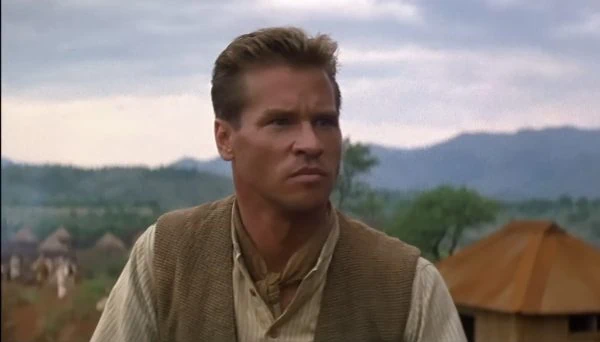
The late Val Kilmer was an actor who was admired and loved by all in the industry for his sheer talent and commitment to the craft. A product of Julliard, Kilmer started his career as a stage actor before moving on to feature film, dishing out unforgettable performances in top-notch efforts such as Top Gun, The Doors, Tombstone and Heat. After Tom Cruise declined the opportunity to play John Henry Patterson and Kevin Costner walked away from the project, Kilmer who’d just finished making Batman Forever for Warner Bros., expressed interest in Goldman’s script and playing Patterson’s character, as he loved Africa and regularly travelled there. His involvement cemented the fate of the production and it immediately got fast-tracked. However, the young actor was exhausted by his experience working on the much maligned The Island of Dr. Moreau which had a very problematic production. This sadly didn’t give Kilmer much time to prep for his role before shooting on The Ghost and the Darkness commenced but suffice to say the performer more than delivered and then some.
Sean Connery and Anthony Hopkins were considered for Remington’s role
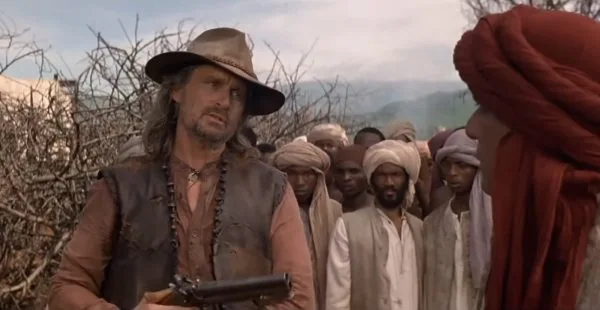
Michael Douglas is an award-winning actor and producer with a career spanning close to five decades. Douglas earned his first Oscar as producer of One Flew Over the Cuckoo’s Nest in 1975. He would then go on to win the Academy Award for Best Actor for his unforgettable portrayal of ruthless corporate raider Gordon Gekko in the 1987 crime drama Wall Street. When Douglas joined the production of The Ghost and The Darkness, he originally came on board as producer but once Sean Connery and Anthony Hopkins turned down the opportunity to play Charles Remington, Douglas decided to do it himself. This inevitably led to massive changes in Goldman’s script as Douglas wanted to expand his character’s role but these revisions came at a cost. Before, the script painted Remington as an enigmatic individual with a mysterious past but once the character was expanded everything changed and in Goldman’s book “Which Lie did I tell?” the screenwriter detailed that Douglas’ creative decisions ruined the enigma the character possessed, essentially making him a “wimp” and a “loser”.
The movie’s production was a famously troubled one
The Ghost and the Darkness had somewhat of a troubled production due to a multitude of reasons. Chief of which was the dangers posed to the cast and crew by the local wildlife and natural elements of South Africa. The temperature routinely went over a blistering 100 degrees and freak thunderstorms perpetually wreaked havoc, threatening to derail the shoot on many occasions. During a behind-the-scenes interview director Stephen Hopkins detailed the harrowing experiences he encountered on set in the following manner, “We had snake bites, scorpion bites, tick bite fever, people getting hit by lightning, floods, torrential rains and lightning storms, hippos chasing people through the water, cars getting swept into the water, and several deaths of crew members including two drownings”. Working with Douglas also caused considerable distress to Hopkins as he had a very tense working relationship with the actor cum producer at the very outset. Things worsened when Douglas re-cut the entire movie during postproduction just to give himself more screen time. Needless to say Hopkins was thoroughly displeased with the final cut of the movie.
Only one scene in the movie employed an animatronic lion as a substitute

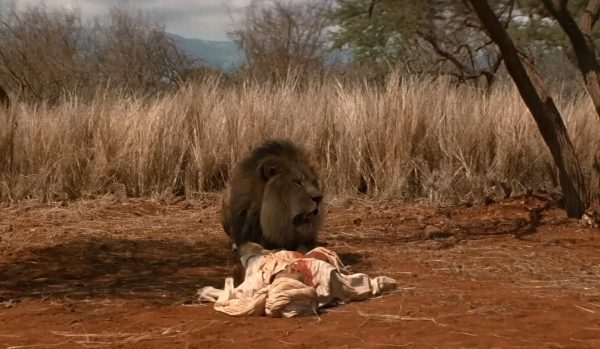
The Ghost and the Darkness only utilized a mechanical lion during one pivotal scene in the film. All the other shots used five specially trained adult male African lions who were namely – Bongo and Ceaser provided by the Bowmanville Zoo in Clarington, Ontario, Canada (the pair also appeared in George of the Jungle), Woltan and Roman given by Animal Actors in Hollywood, in Thousand Oaks, California and Sudan an experienced animal actor from France who previously appeared in Big Top Pee-Wee and Out of Africa. A team from Stan Winston Studios led by effects supervisor John Rosengrant worked on the creation of the animatronic lion. To give the lions their almost mythological appearance, the team made the sculpture of their lion around ten percent larger than the average lion and Rosengrant rationalized this creative decision by elaborating, “The underlying idea of the story was the question of whether the lion attacks were Africa herself rising to rebel against the building of this railroad or just attacks by rogue lions. There was that mythological aspect to the story, and so these lions needed to look like more than normal animals”. Although the real-life maneaters were a rare maneless variety native to the Tsavo region, the lions used in the film were fully maned regular lions, so as to avoid unnecessary confusion among audiences.
The stunning musical score was crafted by none other than Jerry Goldsmith
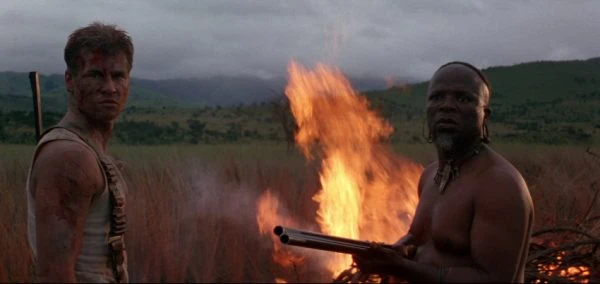
In the sphere of film composing very few musicians have the disparate catalogue that the likes of Jerry Goldsmith can boast. In his 49 years career Goldsmith was nominated a whopping eighteen Academy Awards and ultimately achieved success with his positively blood-chilling score for 1976’s supernatural horror The Omen. The composer has provided the iconic sound for multiple big-budget franchises including Star Trek, Rambo and Planet of the Apes, and have written the music for such genre classics as Logan’s Run, Patton, Chinatown, Alien, Poltergeist, Total Recall, Basic Instinct and L.A. Confidential. Director Stephen Hopkins certainly knew what he was doing when he enlisted Goldsmith’s talent to write the score for his action-adventure creature feature and the musician delivered one heck of an ethnically charged score that seamlessly interweaved African rhythms along with traditional Irish folk melodies.
The film was shot by acclaimed cinematographer Vilmos Zsigmond
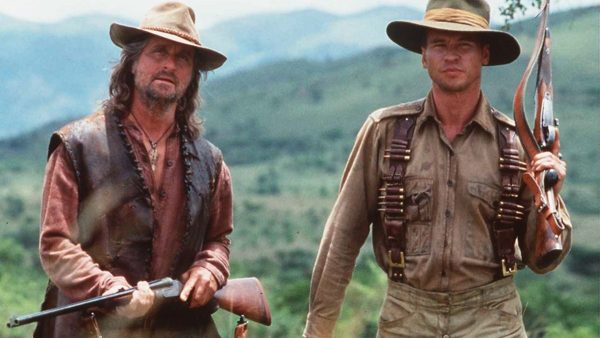
Cinematographer Vilmos Zsigmond was one of the most influential DOPs who helped shape the look of the 1970s American movies, which inevitably made him a leading figure of the New Wave movement of that era. Some of his notable work can be seen in efforts such as John Boorman’s Deliverance, Robert Altman’s The Long Goodbye, Michael Cimino’s The Deer Hunter and Stephen Spielberg’s Close Encounters of the Third Kind, the latter of which garnered him the Academy Award for Best Cinematography. When making The Ghost and the Darkness, director Stephen Hopkins wanted to have his regular DOP Peter Levy to work with him on this production as well. This decision was unfortunately vetoed by the producers who wanted Vilmos Zsigmond to lens the effort. As a result, Zsigmond and Hopkins’ relationship was strained at first. However, with time the pair resolved their differences and eventually their relationship became a positive one, especially after Hopkins saw what Zsigmond had achieved as the film’s DOP.
Lackluster box-office, mixed critic reviews and the birth of a cult-hit
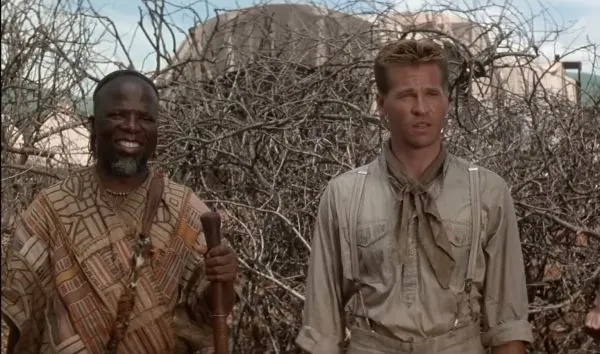
In spite of the lavish production values, old-school action adventure narrative and the involvement of two Hollywood heavyweights, the box-office impact of The Ghost and the Darkness was lackluster, with the movie achieving only $75 million out of its total production budget of $58 million. The response by film critics was also a mixed one with review aggregator site Rotten Tomatoes giving it a 51% rating based on 53 reviews, as of writing. The site’s critical consensus summed up the film in the following manner: “The Ghost and the Darkness hits its target as a suspenseful adventure, but it falls into a trap of its own making whenever it reaches for supernatural profundity”. The mixed reception certainly didn’t stop the flick from nabbing an Academy Award for Best Sound Editing the following year but Kilmer had the misfortune of being nominated for a Razzie Award for Worst Supporting Actor for both The Ghost and the Darkness and The Island of Dr. Moreau.
Since its release 30 years prior the film has gone onto become a cult-hit due to fans appreciating its many strengths and overlooking its deficiencies and the behind-the-scenes drama. Because of this, the movie has often been regarded as a top-tier creature feature replete with nail-biting suspense, compelling performances, a phenomenal musical score and breathtaking cinematography. The mystique surrounding the terrifying true story of the 1898 Tsavo man-eaters also contributes to keeping the legacy of this masterful animal horror adventure alive, even to this day.
What are your thoughts on The Ghost and the Darkness? Let us know on our socials @FlickeringMyth…
Hasitha Fernando is a part-time medical practitioner and full-time cinephile. Follow him on Twitter via @DoctorCinephile for regular updates on the world of entertainment.