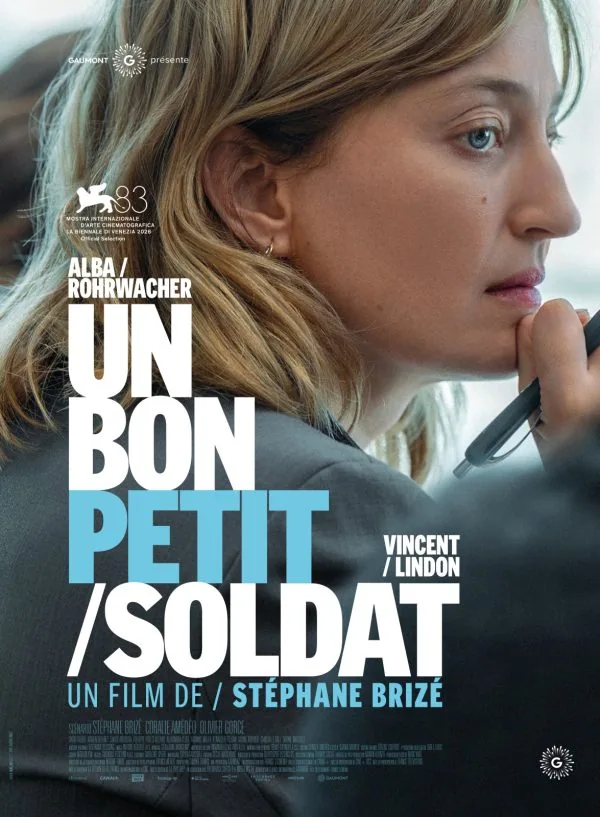
A Good Little Soldier, 2026.
Directed by Stéphane Brizé.
Starring Alba Rohrwacher, Vincent Lindon, David Talbot, and Sharif Andoura.
SYNOPSIS:
Follows Carla, a 43-year-old high-performing executive newly recruited as HR manager of a major insurer, tasked with rebuilding its brand in a corporate environment where vulnerability is not an asset.
Human resources (HR), in theory, should be an entity that protects employees from the abuse of corporate overlords. However, that is rarely the case. Due to how closely intertwined it is with the company, it often becomes a tool that people in positions of power abuse. A Good Little Soldier wants to explore the nuances of HR and the hypocrisy of people trained to de-escalate conflict. While some of its messaging does not entirely land, the film still has a prickly impact, leaving you feeling as empty as its lead character.
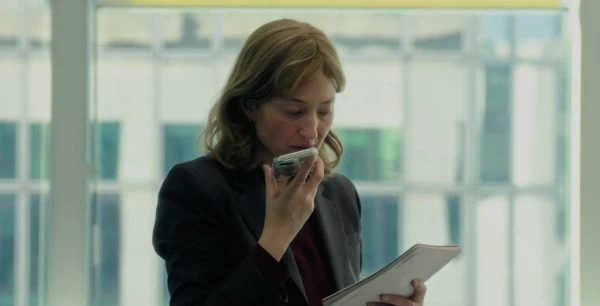
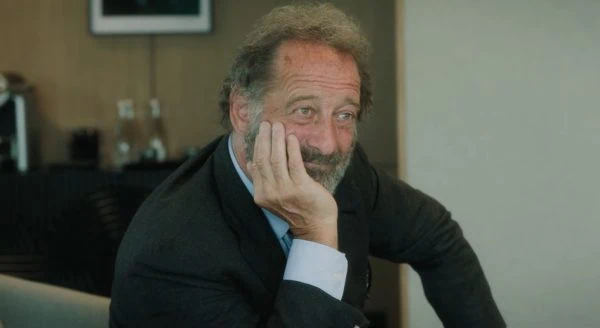
We follow Carla (Alba Rohrwacher), who has recently taken on the role of HR manager at a French insurance company. There, she is pushed to her moral limits while attempting to rebrand the company’s image mainly through a promotional video. Along the way, she faces numerous challenges, including a brash and demanding CEO, Arnauld (Vincent Lindon), and a colleague who is being abused by her manager.

Comedy stemming from a deranged CEO spouting ableist language should not work in 2026, yet in this film it does. Crucially, the comedy does not come from laughing at disadvantaged people, but from the ramblings of a CEO who can make these vulgar remarks and face few repercussions. Inclusion, diversity, and demonstrating that intolerance will not be accepted are important. Yet when these rules are broken, there should not be different standards of accountability. Upper management often faces little to no punishment, while lower-level employees can find themselves facing disciplinary action.
This idea of tiered punishment is highlighted after an audio recording of a manager yelling at a colleague is handed to Carla. What should be an open-and-shut case of workplace abuse instead becomes a game of diplomatic chess. HR attempts to justify why the incident occurred, arguing that the colleague who suffered the abuse is performing at only 100%, while the rest of the team is operating at 130%, suggesting there is more to the story. What begins as an open-and-shut case gradually evolves into something far more sinister: the justification of heinous behaviour.
The film attempts to contrast this instance of a manager yelling at a colleague with Carla shouting at her son over maths problems. However, it feels like a false equivalence given the vastly different contexts and circumstances leading up to these moments. While her outburst towards her child is undoubtedly unacceptable, she has already been put through the wringer, juggling the fallout from the audio recording while also trying to ensure the video is completed.
As a result, it feels more like the boiling over of pent-up frustration than a reflection of her normal behaviour. Furthermore, we are told before the recording is passed to HR that this is not the first time the manager has acted in such a manner. This makes the comparison, and the film’s commentary on hypocrisy, feel hollow. However, what never falters is Antoine Héberlé’s cinematography, which captures the manic nature of this office environment beautifully. This is combined with the bizarre yet effective editing of Géraldine Mangenot, which has erratic cuts that should be distracting but reflect the environment the characters exist in.

The film is entirely performance-driven, with the brilliant Rohrwacher as Carla being front and centre. She truly delivers an incredible performance that allows the slow descent into capitalist depression to be utterly believable. Her long looks of depression are nothing short of soul-destroying. Lindon as Arnauld is hauntingly repugnant as a deranged CEO who, no matter how vulgar they become, is protected by the capitalist system. The rest of the cast is also great, allowing for every scene to work effectively.
Stéphane Brizé has delivered a feature that is both shockingly funny and deeply poignant. By its conclusion, A Good Little Soldier leaves you feeling cold, forcing you to confront the reality that we live in a society that allows toxic behaviour to thrive when power and control are valued above all else. It makes you wonder whether you, too, are a good little soldier for the corporate overlords, and to me, that is the mark of a truly powerful film.
Flickering Myth Rating – Film: ★ ★ ★ ★ / Movie: ★ ★ ★ ★
Robert Ewing