Being Heumann, 2026.
Directed by Sian Heder.
Starring Ruth Madeley, Mark Ruffalo, Dylan O’Brien, Madeline Delp, Rio Finnegan, Rob Delaney, Ray Fisher, Michael Patrick Thornton, Antwan Tolliver, David Hewlett, Daniel Durant, Jon Beavers, Roberta Colindrez, Siena Raftern, Andrew Pilkington, Rein Barcel, Darcee Charington Neal, Russell Harvard, Charlie Rush-Reese, and Will Brill.
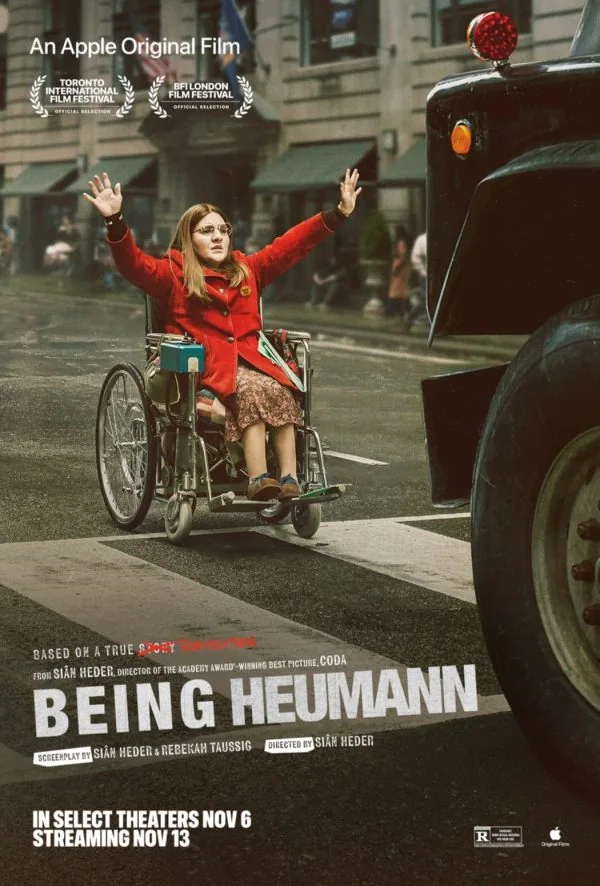
SYNOPSIS:
In 1977, disability rights activist Judy Heumann leads a historic 28-day occupation of San Francisco’s Federal Building, uniting protesters in a fight for accessibility laws and equal rights.
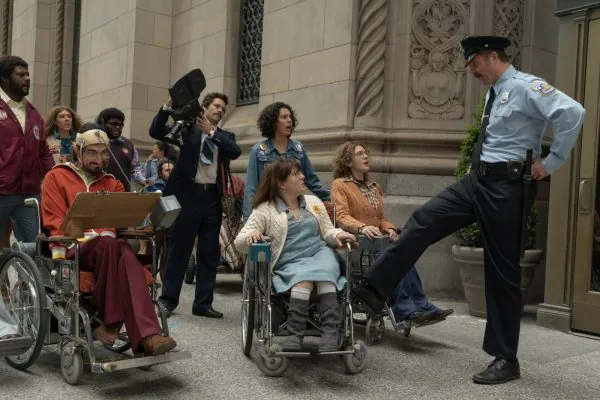
A line in Being Heumann, from one of the many disabled characters and, more importantly, from the different types of disabilities on display, goes something like: “don’t be inspired; be inspired to do something.” It is what tries to separate CODA filmmaker Sian Heder’s biopic – about the 1977 San Francisco Federal Building sit-in protest led by Judy Heumann (a remarkable performance from Ruth Madeley that, strangely enough, is so alive and filled with righteous anger and dynamism that being in a wheelchair yields no limitations or restrictions as an actor) with fierce determination to get Department of Health Education and Welfare Secratary Joseph Califano (a frugal, sardonic Mark Ruffalo) to sign in the 504 regulations of the Rehabilitation Act of 1973 – from other movies centering disabled characters (particularly wheelchair users), and yet something one wishes her and co-writer Rebekah Taussig (also disabled) pushed (absolutely no pun intended) a little bit further in that direction rather than consistently pulling back from harshrealities of its days-long situation to ensure a feel-good vibe always quick to work in some disability-centric humor.
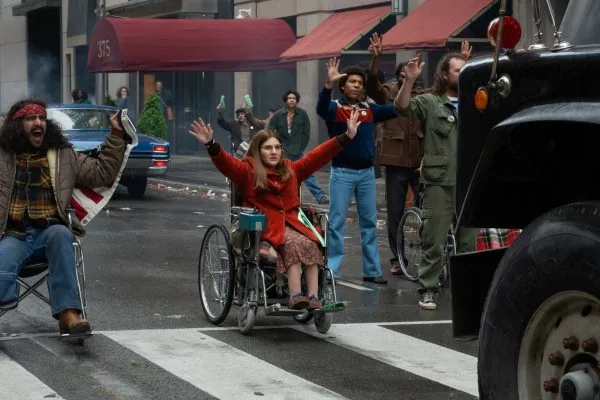
Sian Heder deserves deep admiration and respect for putting this story on screen and filling it with what is likely the most representation ever in a single film, while also taking time for brief observations of the ins and outs of disability life and caretaking. Disability advocates, supporters, and caretakers help with moving wheelchairs up and down sidewalks (for those unfamiliar, the 504 regulations would make it mandatory for there to be ramp-like gaps to do so without lifting, and require all federal buildings to provide accessibility), changing and dressing, helping to the bathroom, showering (getting creative inside the building, as there are no accessibility friendly resources), the specifics in how a disabled person wants to be lifted and laid down all the way down to the fact that some of these people need help being turned from side to side every few hours in the middle of the night. Hell, one of the first shots shows a crowd of streetwalkers marching forward past Judy without any disregard of her existence, safety, or bumping into the chair, which hasn’t changed in modern times while demonstrating how careless and inconsiderate the able-bodied can be.
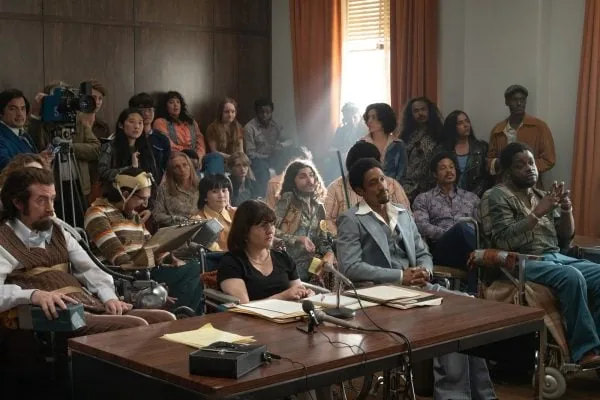
Again, having an assortment of disabled actors and screenwriter will provide that level of authenticity, the kind where people like me can’t help but feel that simply giving the film time to show such small details or giving an important role to someone with a muscular condition and vastly unique body and limb shapes, is revolutionary and moving in itself. It’s also a film that talks about how physically uncomfortable and terrifying it would be for those disabled individuals to fully commit to the protest, even if it is more concerned with the party-like antics that go down and a sense of joviality. Sure, that was part of it, but the script is just as quick to drop whenever the various types of disabled (ranging from physical conditions to blindness and deafness and more) get into a debate about 504 and what they want from it, as one change in the world that might be beneficial to someone could be considered a different kind of hindrance for someone else.
Naturally, this also tests Judy’s abilities as a leader of the movement, or it would, if the film didn’t keep reverting to optimism, jokes, punkish needle drops, and a biopic blueprint. Seeing myself in many of these characters, particularly Milton (who I believe has muscular sclerosis, played by Rio Finnegan), but also coming away feeling like much of it is also a cornball stew might be the epitome of frustration in my career reviewing movies thus far; Sian Heder’s intentions are incredible and pure, but her directorial style clashes with both my taste and an approach that actually feels radical.
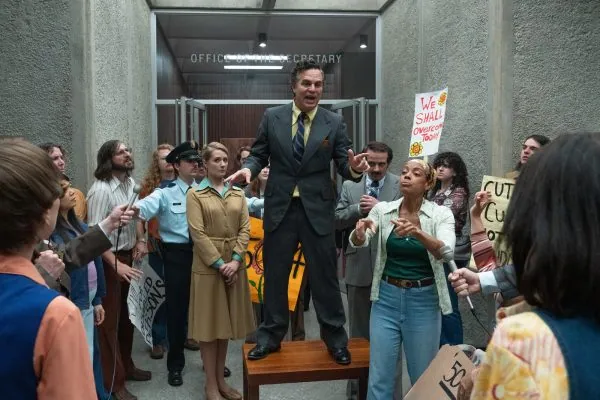
There is perhaps no greater example of this than when the protest takes a turn directly to Joseph Califano’s home, with the disabled protesters having them and their wheelchairs put into the back of the U-Haul, which is played as something adjacent to a mild action scene rather than giving over to the reality that without any kind of restraints to keep the wheelchairs in place, and even with able-bodied characters holding on, it is still dangerous and scary. That fear, not just in this scene but across the rest of the film, feels largely unexplored because someone decided it had to be upbeat and leave us feeling happy. It ends by saying there is work to be done, which is nice; not cutting in front of someone in a wheelchair just because they are driving slower than you would like would be a good start.
Again, Being Heumann is most successful as a depiction of what it looks like to be disabled and depend on others for assistance, addressing situations most films would gloss over. The film even makes time for a moment of intimacy between Judy and a hunky activist who admires her, where she takes it in a dominant direction, saying “now you’re going to do what I say”, as that sort of role-play is a fantastical release and one of the only times someone physically disabled can have some form of control in their lives.
Also present is Dylan O’Brien as a beat reporter assigned to the protest, who starts off clueless and cracking off-color jokes (admittedly, some of which I laughed at, because what the hell can you do but also try to find humor in being different). As he grows into an ally, his empathetic arc could serve as a cipher for how viewers can change for the better. Fittingly and movingly, the film also gives each disabled protester character beyond their condition while exploring why they protest.
Seeing these people for more than their disabilities carries the film a long way, smoothing over some tonal frustrations. Credit to Sian Heder and especially the remarkable disabled ensemble for what they have accomplished here, but Being Heumann, while full of observations on disabled life, unfortunately gets too busy being hokey and paint-by-numbers in its storytelling.
Flickering Myth Rating – Film: ★ ★ ★ / Movie: ★ ★ ★
Robert Kojder