Coinciding with the release of his latest film The Mongoose, Casey Chong looks at a selection of Liam Neeson’s best non-action movies…
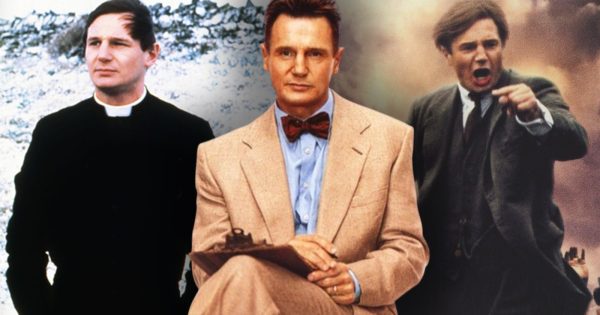
Releasing today, The Mongoose marks 74-year-old Liam Neeson’s latest foray into action, which has been dominating his filmography for nearly two decades since Taken in 2008, even though he has previously mentioned his plan to retire from the genre that revitalized his career. Beyond the action genre that most people today have grown accustomed to with his work, Neeson has always been a versatile actor who can effortlessly transition from dramatic to romantic and even comedy performances. With that said, here are eight of Liam Neeson’s best non-action movies…
Schindler’s List (1993)
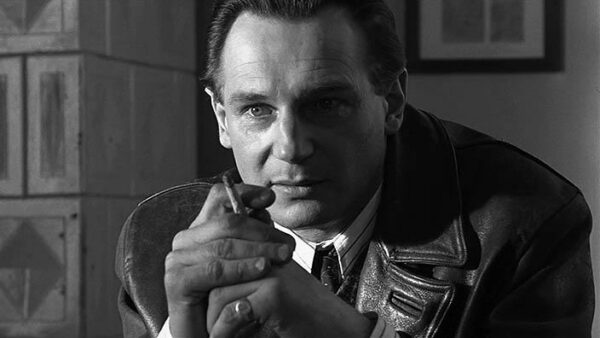
Still his finest performance to date, Liam Neeson’s remarkably subtle portrayal of Oskar Schindler remains his only Oscar nomination for Best Actor in his illustrious career. First introduced as an opportunist who sees war during World War II as a way to make a profit through slave-labor exploitation, military contracts, and enamelware factory takeover, Neeson’s initially cold and corrupt Nazi-supported industrialist gradually undergoes a transformative character arc following the turning point of the Kraków Ghetto massacre, notably with the arrival of a ruthless SS commandant, Amon Göth, played to clinical precision by Ralph Fiennes.
His subsequent conscience adds both dramatic and emotional weight to his character, and Neeson plays the role with deep restraint. Schindler’s List was a high-water mark for Steven Spielberg, who already enjoyed a banner year with Jurassic Park, as he expertly navigates this three-hour epic, blending stunning yet raw visuals through Janusz Kaminski’s stark black-and-white cinematography, and intimate, all-encompassing human drama. The movie was a huge hit, earning over $320 million worldwide on a $22 million budget, and went on to score seven Oscars.
Kinsey (2004)
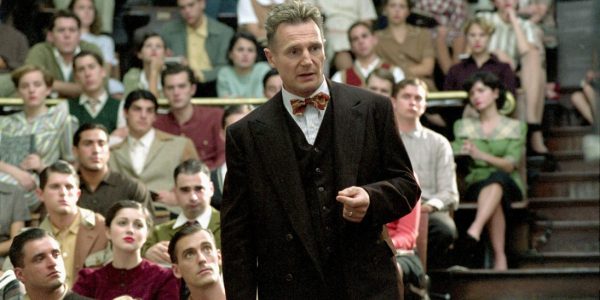
Writer-director Bill Condon’s biographical account of the trailblazing Professor Alfred Kinsey in his scientific study of human sexuality is as bold and controversial as the real-life figure himself. Liam Neeson delivers one of his best performances to date, bringing enough nuance to his titular role that’s both daring and profoundly human. It’s a pity the Academy somehow robbed him of a much-deserved Best Actor nomination, even though his co-star, Laura Linney, secures a Best Supporting Actress nomination for her emotionally understated turn as Kinsey’s wife.
The movie offers an honest look at Kinsey’s professional and personal life, chronicling his journey from growing up in a strict household to falling in love with his eventual wife, Clara McMillen, during his academic years, and pioneering sex education and experimentation in the name of science while breaking the societal mid-century taboo at the time. Condon keeps his direction grounded and doesn’t shy away from exploring the subject of sex both thematically and visually without coming across as exploitative and gratuitous.
Michael Collins (1996)
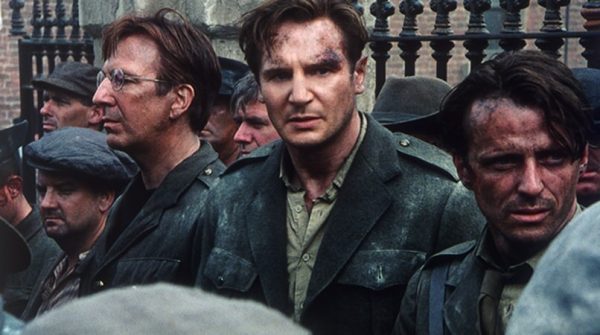
Liam Neeson is the beating heart and soul of Neil Jordan’s thrilling biographical drama in Michael Collins, playing the titular Irish revolutionary leader who boldly fights for his country’s independence between the 1916 Easter Rising and the early 1920s Anglo-Irish Treaty and Irish Civil War. He brings charisma and energy to his commanding presence, earning a Golden Globe nomination for Best Actor and even winning the prestigious Volpi Cup at the Venice Film Festival.
Unfortunately, the Academy completely snubbed him, with the movie garnering only technical nominations for Best Cinematography and Best Original Score. Despite clocking in at 132 minutes, Jordan’s assured direction keeps the movie moving at a brisk pace, reminiscent of a ticking-clock, high-stakes thriller focusing on urban guerrilla warfare, street protests, and political intrigue. At the time of its release, Michael Collins made box-office history as the highest-grossing movie in Ireland, even eclipsing the previous record-holding Jurassic Park.
Lamb (1985)
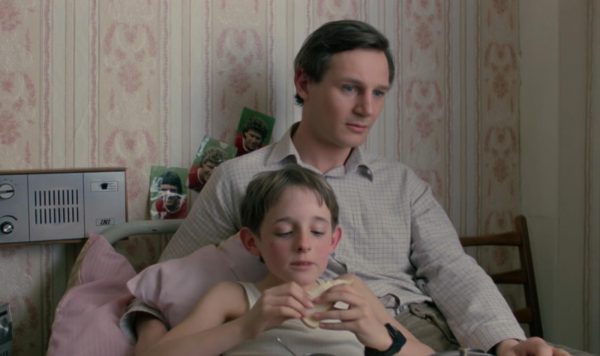
Long before Liam Neeson made his career breakthrough in Schindler’s List, he led this little-known drama about a Catholic religious brother who loses his faith after witnessing the reform school’s emotional and physical abuse of an epileptic yet troubled 10-year-old boy, Owen Kane (a terrific Hugh O’Conor, who brings a rebellious spirit to his role). Neeson, who plays Brother Sebastian, becomes disillusioned that the only way to protect the child is to sneak him out of the school and flee to London.
Directed by Colin Gregg, who adapted Bernard MacLaverty’s 1980 novel of the same name, Lamb focuses primarily on the father-and-son-like dynamic between Brother Sebastian and Owen Kane. Both share a deep, mutual connection stemming from the broken institutional system. Their on-screen chemistry strips off the typical surrogate father-son bonding clichés, favoring instead an unforced build-up based on the characters’ gradual trust and interaction as they spend time together on the run.
Neeson’s pre-fame performance already showcases his impressive dramatic range without succumbing to over-the-top histrionics. The movie also doesn’t sugarcoat the reality of living as fugitives, shifting from an initially idealistic yet noble mission to save a child to an unflinchingly gritty survival story. The latter is especially true with Owen’s severe medical condition and Brother Sebastian, a.k.a. Michael Lamb’s financial hardship, culminating in a bleak third act on a secluded beach.
Ordinary Love (2019)
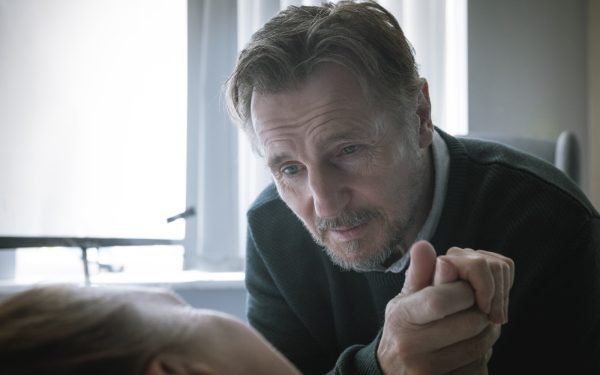
A refreshing change of pace for the post-Taken era’s Liam Neeson leads a romantic drama in Ordinary Love; co-directors Lisa Barros D’Sa and Glenn Leyburn eschew the usual Hollywood tearjerker with none of the melodramatic route for a matter-of-fact approach. Primarily a two-hander, the movie highlights the trials and tribulations of Tom (an understated Liam Neeson) and Joan (a scene-stealing Lesley Manville) Thompson, who have been happily married for a long time, only for their otherwise strengthening bond to become an ultimate litmus test following Joan’s suffering from breast cancer.
The effortless on-screen chemistry between Neeson and Manville makes their initial affection feel heartbreaking as the reality of the diagnosis sets in – the gradual anxiety over learning about the breast cancer, the brutal side effects of chemotherapy, and the increasingly volatile behavior and emotional burnout that jeopardize the foundation of Tom and Joan’s marriage.
Under Suspicion (1991)

Liam Neeson plays Tony Aaron, a disgraced character in Under Suspicion, beginning with his affair with the wife (Maggie O’Neill’s Hazel) of a criminal (Alan Talbot’s Powers) during a nighttime stakeout. Tony’s sexual tryst quickly leads to his downfall, and he has since made a living as a private investigator specializing in divorce scams with his now-wife, Hazel. The story quickly reaches a turning point: a supposedly routine scamming tactic involves Hazel being used as bait to seduce a client into sleeping with her in a hotel, where it ends in a gruesome double murder, even making Tony a prime suspect.
Writer-director Simon Moore structures Under Suspicion as a mix of neo-noir and erotic thriller, with a storytelling hook that largely lies in Tony’s desperate attempt to clear his name while subsequently falling for the dead client’s mistress, Angeline (Laura San Giacomo). Neeson’s performance is the highlight of this movie, subtly combining sleaze and moral ambiguity in his deeply flawed character.
Love Actually (2003)
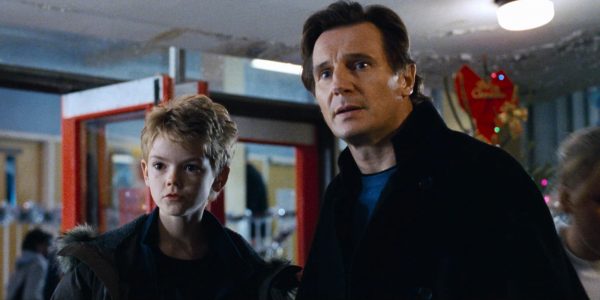
Richard Curtis’s Christmas-themed ensemble rom-com, Love Actually, boasts an all-star cast covering Hugh Grant to Keira Knightley, Alan Rickman and Colin Firth in a series of interconnected stories, highlighting different characters’ stages of love and relationships. One of them is Daniel (Liam Neeson), who recently lost his wife and is trying to bond with his stepson Sam (pre-Game of Thrones and The Queen’s Gambit’s Thomas Brodie-Sangster). He learns that Sam has been struggling to get the attention of his crush, Joanna (Olivia Olson), at school, prompting him to find a way to help his stepson. Neeson delivers a grounded performance that balances his act between a grieving widower and a supportive stepfather, with the latter shining the most throughout his on-screen bonding with Thomas Brodie-Sangster’s adolescent stepson role. Love Actually was a huge hit that year and has since become a holiday staple.
The Naked Gun (2025)

On paper, The Naked Gun franchise effectively ended after Leslie Nielsen, who immortalized the bumbling Frank Drebin role, passed away. But Hollywood has a penchant for rebooting or continuing a franchise. This brings us to a legacy sequel with Liam Neeson stepping in as the late Drebin’s son. The jokes fly thick and fast throughout the movie’s lean 85 minutes, where any longer would have overstayed its welcome.
The good news is that Neeson proves to be a worthy successor to the late Leslie Nielsen, who already showcased his comedic chops in movies like The A-Team and The LEGO Movie. He nails the right blend of cynical action-hero gravitas and deadpan personality, playing his role straight amidst the movie’s sheer absurdity and zany chaos. The Naked Gun also benefits from Neeson’s on-screen chemistry with Pamela Anderson, notably their scenes together in Austin Powers: The Spy Who Shagged Me-style sexual innuendo and a hilariously bonkers subplot that pays homage to corny ‘80s romance and ‘90s B-movie horror.
What are your favourite Liam Neeson movies outside of the action genre? Let us know on our social channels @FlickeringMyth…
Casey Chong